
Blog
Battery Sizes and IEC Codes: Voltage, Chemistry and Fit
Decode CR2032, LR6, 18650 and other battery names, then compare dimensions, chemistry and voltage before choosing a replacement.
I was working on a project called Cellarium—a modular storage system designed to keep batteries organized, protected, and easy to identify.
At first, the project appeared straightforward: measure the batteries, design the compartments, and build the boxes.
But while working through the dimensions of AA, AAA, 18650, 21700, coin cells, button cells, and other battery formats, I started noticing something more interesting.
The names often appeared to contain clues about the batteries themselves.
Why is an 18650 called an 18650? Why does a CR2032 carry those particular letters and numbers? Do the codes describe diameter, length, chemistry, voltage, construction, or something else?
There had to be a system behind them.
Questions like these are always sitting somewhere in the back of my mind. Once I notice a pattern, I want to understand the logic behind it—and that usually leads me down a much deeper rabbit hole than I originally planned.
That is also how PlateLab began. A practical electroplating calculation problem turned into a broader effort to understand, organize, and explain the engineering behind the process.
Because engineering is not a guessing game.
I should also be honest: I regularly design enclosures for prototypes and mass-manufactured devices, and one of the most common requirements is something along the lines of:
“Leave enough space for this battery.”
Or:
“Make sure these batteries are held securely.”
That means this article is not only an explanation of battery sizes, naming systems, chemistries, and voltages. It will also become a practical reference guide for my future projects—something I can return to whenever I need to design a battery compartment, holder, enclosure, or retention system.
And if you are not interested in following me all the way down this particular rabbit hole, there is an interactive battery reference menu near the end of the article. You can select a battery type and quickly view its dimensions, nominal voltage, chemistry, and common alternative names without reading the entire post.
Quick answer
Battery codes do not follow one universal dimensional rule. In an IEC primary-cell code such as CR2032, C identifies lithium–manganese dioxide chemistry, R means a round cell, and 2032 indicates about 20 mm diameter by 3.2 mm high. Codes such as LR6 identify a standardized size class rather than spelling out millimetres, while 18650 and 21700 are familiar rechargeable cylindrical-cell format names.
Never substitute a battery because it fits the compartment. Confirm chemistry, nominal and maximum voltage, primary or rechargeable status, terminal arrangement, current capability, manufacturer dimensions and tolerances, and the device maker's instructions.
Table of Contents
- There Is Always a Standard
- Batteries Bring Us into IEC Territory
- The First Letter: The Chemistry Layer
- The Second Letter: The Shape Layer
- Round Does Not Mean One Shape Only
- What Do the Numbers in Battery Names Mean?
- The Similar Logic Behind 18650 and 21700 Cells
- Same Size, Different Names
- Household Batteries: Consumer Names and Technical Names
- The 2032 Size Family
- LR44, SR44 and PR44
- Watch Batteries and the Alias Jungle
- CR123A, CR17345 and 123
- The Practical Battery-Replacement Check
- Battery Reference Tool
- Frequently Asked Questions
- Final Thoughts
There Is Always a Standard
In engineering, there is almost always a standard.
Standardization gives engineers a reliable reference point. It defines dimensions, classifications, test methods, tolerances, performance requirements, and safety limits so that every engineer does not have to solve—and validate—the same problem from the beginning.
You can see evidence of this even while walking down an ordinary European pavement.
Look at a manhole cover and you may find a marking such as:
EN 124 B125
EN 124 is the European standard series covering gully tops and manhole covers used in pedestrian and vehicular areas.
The B125 classification indicates a test load of 125 kN. Covers intended for roads carrying normal vehicle traffic commonly use a higher classification, such as D400.
That small group of letters and numbers communicates something meaningful. It tells an engineer, manufacturer, contractor, or inspector which requirements the component was designed and tested to meet.
The same principle applies throughout engineering.
We regularly work with standards developed, adopted, or published through organizations and systems such as:
- ISO — International Organization for Standardization
- IEC — International Electrotechnical Commission
- IEEE — Institute of Electrical and Electronics Engineers
- ANSI — American National Standards Institute
- EN — European Standards
These standards give us a common technical language and a dependable foundation on which to design.
Instead of guessing what a component should withstand, how large it should be, or how it should be tested, we begin with an established reference.
Batteries are no exception.
Batteries Bring Us into IEC Territory
When we begin looking at standardized battery names, we enter IEC territory.
IEC stands for the International Electrotechnical Commission.
It is not a battery brand or manufacturer. It is an international standards organization responsible for electrical, electronic, and related technologies.
For the primary batteries discussed in this article, the important group of standards is the IEC 60086 series, titled Primary batteries.
The current 2026 structure keeps general nomenclature and classification in IEC 60086-1:2026. Physical and electrical specifications are now split between IEC 60086-2-1:2026 for aqueous-electrolyte primary batteries and IEC 60086-2-2:2026 for standardized lithium primary batteries with non-aqueous electrolytes.
In this context, primary battery means a battery designed for single use rather than recharging.
IEC 60086 covers subjects such as:
- Battery dimensions
- Standardized nomenclature
- Terminal configurations
- Required markings
- Test methods
- Typical performance
- Safety requirements
- Environmental considerations
In plain language, IEC standardization is one of the reasons batteries produced by different manufacturers can carry a common technical designation and still remain compatible in terms of form, fit, and intended function.
A battery compartment should not need to be redesigned simply because the battery placed inside it comes from another manufacturer.
The Basic IEC Battery-Naming Logic
At its simplest, an IEC-style battery designation can contain:
Electrochemical-system letter + shape letter + size code
Additional characters may describe:
- The number of cells
- Cell arrangement
- Construction
- Terminal configuration
- Special performance characteristics
IEC battery names are therefore not arbitrary product names.
They are compressed technical descriptions.
Once we understand how to read them, codes such as LR6, CR2032, SR44, and 6F22 begin to tell us something before we have even picked up the battery.
The First Letter: The Chemistry Layer
The first layer of an IEC battery designation identifies its electrochemical system—in other words, the chemistry that produces the electrical energy.
Where IEC assigns an electrochemical-system letter, it is written as an uppercase letter.
This letter is not simply a broad label such as lithium or alkaline. It represents a defined combination of:
- Negative electrode
- Electrolyte
- Positive electrode
- Nominal voltage
- Maximum open-circuit voltage
Electrochemical systems are conventionally described by naming the negative electrode first, followed by the positive electrode.
For example, the F system is described as lithium–iron disulfide, rather than iron disulfide–lithium.
| IEC letter | Negative electrode | Electrolyte | Positive electrode | Nominal voltage |
|---|---|---|---|---|
| B | Lithium Li | Organic electrolyte | Carbon monofluoride (CF)x | 3.0 V |
| C | Lithium Li | Organic electrolyte | Manganese dioxide MnO₂ | 3.0 V |
| E | Lithium Li | Non-aqueous inorganic electrolyte | Thionyl chloride SOCl₂ | 3.6 V |
| F | Lithium Li | Organic electrolyte | Iron disulfide FeS₂ | 1.5 V |
| G | Lithium Li | Organic electrolyte | Copper(II) oxide CuO | 1.5 V |
| L | Zinc Zn | Alkali-metal hydroxide | Manganese dioxide MnO₂ | 1.5 V |
| P | Zinc Zn | Alkali-metal hydroxide | Oxygen O₂ | 1.4 V or 1.45 V |
| S | Zinc Zn | Alkali-metal hydroxide | Silver oxide Ag₂O | 1.55 V |
| W | Lithium Li | Organic electrolyte | Sulfur dioxide SO₂ | 3.0 V |
| Y | Lithium Li | Non-aqueous inorganic electrolyte | Sulfuryl chloride SO₂Cl₂ | 3.9 V |
| Z | Zinc Zn | Alkali-metal hydroxide | Nickel oxyhydroxide NiOOH | 1.5 V |
Nominal voltage is a reference value used to identify and compare an electrochemical system. It should not be interpreted as the exact voltage a battery will maintain throughout its complete discharge cycle.
This first letter already tells us a considerable amount.
For example:
| Letter | Practical meaning |
|---|---|
| L | Alkaline zinc–manganese dioxide system |
| C | Lithium–manganese dioxide system |
| F | Lithium–iron disulfide system |
| S | Zinc–silver oxide system |
| P | Zinc–air system |
This is why two batteries with nearly identical dimensions can behave very differently electrically.
Their physical dimensions may determine whether they fit inside a device, but their chemistry affects:
- Nominal voltage
- Discharge curve
- Internal resistance
- Capacity
- Pulse-current capability
- Storage life
- Operating-temperature range
- Suitable applications
There is also an important exception.
The conventional zinc–manganese-dioxide system, commonly associated with zinc-carbon batteries, is represented by no electrochemical-system letter.
That is why we see:
- R6 for a zinc-based AA-size primary cell
- LR6 for an alkaline AA-size primary cell
- FR6 for a lithium–iron disulfide AA-size primary cell
The size remains similar, but the chemistry letter changes—or disappears entirely.
The Second Letter: The Shape Layer
After the electrochemical-system letter comes the physical shape designation.
In most battery names encountered in daily use, this letter is R.
One common misunderstanding should be cleared up immediately:
R does not mean rechargeable. R means round.
IEC uses R for cells and batteries with a circular cross-section.
This broad category includes:
- Tall cylindrical cells
- Short button cells
- Flat coin cells
| Shape letter | Meaning | Physical concept | Examples | Notes |
|---|---|---|---|---|
| R | Round | Circular cross-section | LR6, LR44, SR44, CR2032, CR123A | The most common shape letter |
| F | Flat, layer-built | Flat cells constructed in layers | 6F22 | Primarily associated with older designation logic |
| S | Square | Square or rectangular cell construction | Legacy designations | Rare in modern consumer discussions |
| P | Non-round | Prismatic or otherwise non-round envelope | Post-1990 non-round designations | Less common in everyday battery names |
In the older IEC designation system, R, F, and S represented round, flat layer-built, and square cells.
A later dimensional system uses:
- R for round batteries
- P for non-round batteries
The position of a letter therefore matters.
For example, P can identify zinc-air chemistry when it appears in the electrochemical-system position, but it can identify a non-round shape when it appears in the shape position.
A Flat Battery Is Not Necessarily an F Battery
The familiar 3LR12 is often called a flat battery because its external case is rectangular and relatively flat.
However, its designation can be separated as:
| Part | Meaning |
|---|---|
| 3 | Three cells connected in series |
| L | Alkaline chemistry |
| R | Round cells |
| 12 | Standardized R12 cell-size class |
The complete battery looks rectangular from the outside, but its IEC designation refers to the round cells used inside its construction.
This is a good example of why battery codes should be interpreted as technical descriptions rather than guessed from the visible outer shape alone.
Round Does Not Mean One Shape Only
In IEC terminology, round is a broad geometric family.
It includes tall cylinders, low-profile button cells, and flat lithium coin cells.
| Round subtype | Practical definition | Height compared with diameter | Examples |
|---|---|---|---|
| Cylindrical cell or battery | A round cell whose height is equal to or greater than its diameter | Height ≥ diameter | LR6, LR03, CR123A |
| Button cell or battery | A small round cell with an aqueous electrolyte | Height < diameter | LR44, SR44, SR626 |
| Coin or lithium-button cell | A small round cell with a non-aqueous electrolyte | Height < diameter | CR2016, CR2025, CR2032 |
Button cells and lithium coin cells can have similar proportions, but IEC also distinguishes them through their electrolyte systems.
Physically, 18650 and 21700 lithium-ion cells also belong to the cylindrical family. However, their familiar numerical format names are associated with rechargeable cylindrical lithium-ion cells rather than the IEC 60086 primary-battery designation sequence.
The important lesson is:
R tells us that the battery is round. The numbers tell us which round format it belongs to.
What Do the Numbers in Battery Names Mean?
The letters have told us about the battery’s chemistry and physical form.
The numbers that follow usually point us toward its size—but they do not always do so in the same way.
This is where battery naming becomes both useful and slightly untidy.
Some numerical codes work almost like miniature dimensional drawings. Others use compressed dimensional shorthand. Older designations may identify only a standardized size class, meaning the actual dimensions must be obtained from the relevant standard or manufacturer drawing.
First identify the naming family rather than assuming that every printed number converts directly into millimetres:
| Code type | Example | How to interpret it |
|---|---|---|
| Direct dimensional | CR2032 | Approximately 20.0 mm diameter × 3.2 mm high |
| Cylindrical format | 21700 | Approximately 21 mm diameter × 70 mm long |
| Partially dimensional | LR1130 | Approximately 11.6 mm diameter × 3.0 mm high |
| Partially dimensional | SR626 | Approximately 6.8 mm diameter × 2.6 mm high |
| Standardized size class | LR6 | Alkaline AA-size cell |
| Standardized size class | LR44 | Alkaline 11.6 × 5.4 mm button-cell family |
These categories are a practical reading method, not one universal rule. Battery families entered the standards at different times and under different designation systems.
Numbers That Directly Show Battery Dimensions
Lithium coin cells provide the clearest examples.
Consider CR2032:
| Code section | Meaning |
|---|---|
| 20 | Approximately 20.0 mm diameter |
| 32 | Approximately 3.2 mm height |
The height is particularly easy to read because the final two digits express tenths of a millimetre:
- 16 becomes 1.6 mm
- 25 becomes 2.5 mm
- 32 becomes 3.2 mm
- 50 becomes 5.0 mm
- 77 becomes 7.7 mm
The same pattern appears throughout much of the CR coin-cell family:
| Battery | Approximate dimensional meaning |
|---|---|
| CR2016 | 20.0 mm diameter × 1.6 mm high |
| CR2025 | 20.0 mm diameter × 2.5 mm high |
| CR2032 | 20.0 mm diameter × 3.2 mm high |
| CR2430 | 24 mm diameter class × 3.0 mm high |
| CR2450 | 24 mm diameter class × 5.0 mm high |
| CR2477 | 24 mm diameter class × 7.7 mm high |
The diameter section should still be understood as a standardized nominal designation rather than a promise that every physical measurement will match the number exactly.
For example, many CR2450 and CR2477 manufacturer drawings specify an actual maximum diameter of approximately 24.5 mm.
So a dimensional battery name is extremely useful, but the manufacturer’s mechanical drawing remains the final design reference.
Reading CR2032 as a Complete Name
The designation CR2032 can now be separated into three layers:
| Part | Meaning |
|---|---|
| C | Lithium–manganese dioxide chemistry |
| R | Round shape |
| 2032 | Approximately 20.0 mm diameter × 3.2 mm high |
Put together, CR2032 means:
A primary lithium–manganese dioxide battery, round in shape, approximately 20 mm in diameter and 3.2 mm high.
It is a compressed technical description rather than an arbitrary model number.
The Similar Logic Behind 18650 and 21700 Cells
The familiar names used for cylindrical lithium-ion cells follow a related dimensional idea.
| Cell format | Common nominal interpretation |
|---|---|
| 10440 | Approximately 10 mm diameter × 44 mm long |
| 14500 | Approximately 14 mm diameter × 50 mm long |
| 16340 | Approximately 16 mm diameter × 34 mm long |
| 18350 | Approximately 18 mm diameter × 35 mm long |
| 18650 | Approximately 18 mm di…206 tokens truncated…mine whether the battery fits inside a close-tolerance holder. |
The engineering consequence is simple:
Use the format name to understand the general battery size. Use the selected manufacturer’s drawing to design the actual enclosure.
Numbers That Partially Show the Dimensions
Some button-cell designations contain dimensional information, but use a compressed convention.
Consider LR1130:
| Code section | Practical meaning |
|---|---|
| 11 | Approximately 11.6 mm diameter |
| 30 | Approximately 3.0 mm high |
The code is descriptive, but not completely literal. The diameter is normally around 11.6 mm rather than exactly 11.0 mm.
The same partially dimensional logic appears in many small alkaline and silver-oxide cells:
| Battery | Typical dimensions |
|---|---|
| LR1154 | Approximately 11.6 × 5.4 mm |
| LR1130 | Approximately 11.6 × 3.0 mm |
| SR416 | Approximately 4.8 × 1.6 mm |
| SR516 | Approximately 5.8 × 1.6 mm |
| SR621 | Approximately 6.8 × 2.1 mm |
| SR626 | Approximately 6.8 × 2.6 mm |
| SR920 | Approximately 9.5 × 2.0 mm |
| SR927 | Approximately 9.5 × 2.7 mm |
Take SR626 as an example:
- 6 points to the standardized 6.8 mm diameter family
- 26 indicates approximately 2.6 mm in height
Once the shorthand is understood, the name becomes readable. It is simply more compressed than CR2032.
The LR1154 designation is also useful because it exposes the approximate dimensions of the battery commonly known as LR44:
- Approximately 11.6 mm in diameter
- Approximately 5.4 mm in height
Some button-cell names therefore contain dimensional clues without writing the complete dimensions literally.
Numbers That Identify a Standardized Size Class
Other IEC battery numbers do not visibly reveal the dimensions at all.
The clearest example is LR6.
The number 6 does not mean 6 mm.
It identifies a standardized cell size that most consumers know as AA.
| Consumer name | IEC alkaline designation | Meaning of the number |
|---|---|---|
| AAAA | LR8D425 | Standardized AAAA-size designation |
| AAA | LR03 | Standardized AAA-size class |
| AA | LR6 | Standardized AA-size class |
| C | LR14 | Standardized C-size class |
| D | LR20 | Standardized D-size class |
| N | LR1 | Standardized N-size class |
| 9 V | 6LR61 | Six alkaline cells in a standardized battery assembly |
This gives us an important contrast:
AA is the familiar consumer name. LR6 is the IEC-style technical designation.
And:
CR2032 reveals its dimensions almost directly. LR6 does not.
The same issue appears with LR44.
The number 44 is a standardized size reference. It does not mean 44 mm and does not visibly state the cell’s approximate 11.6 × 5.4 mm dimensions.
Same Size, Different Names
After decoding the letters and numbers, we reach another source of confusion:
The same physical battery size can appear under several different names.
This happens for several reasons:
- Consumer names and technical IEC designations coexist
- Different chemistries use the same physical format
- Manufacturers use proprietary product codes
- Retailers use simplified cross-reference numbers
- Older and newer naming systems remain in circulation
These names are useful for identifying a physical size family, but they are not proof of electrical compatibility. A cell may fit perfectly while having the wrong voltage, chemistry, discharge characteristics, charging requirements, or terminal construction.
Same size does not necessarily mean the same battery.
Household Batteries: Consumer Names and Technical Names
Most people refer to household batteries as AAA, AA, C, D, N, or 9 V.
These are familiar size names rather than complete electrochemical descriptions.
The corresponding technical designation changes according to the chemistry placed inside that general physical format.
| Consumer size | Zinc-based primary | Alkaline primary | Lithium primary | NiMH rechargeable |
|---|---|---|---|---|
| AAA | R03 | LR03 | FR03 | HR03 |
| AA | R6 | LR6 | FR6 | HR6 |
| C | R14 | LR14 | — | HR14 |
| D | R20 | LR20 | — | HR20 |
| N | R1 | LR1 | — | — |
| 9 V / PP3 | 6F22 | 6LR61 | Chemistry-dependent | Chemistry-dependent |
This gives us a useful way to read the AA-size family:
| Name | What it communicates |
|---|---|
| AA | Familiar consumer size |
| R6 | Zinc-based AA-size primary cell |
| LR6 | Alkaline AA-size primary cell |
| FR6 | Lithium–iron disulfide AA-size primary cell |
| HR6 | Nickel-metal-hydride rechargeable AA-size cell |
The 6 identifies the physical size class.
The letters tell us which electrochemical system occupies that space.
Rechargeable designations such as HR6 belong to the wider IEC battery-naming system and rechargeable-battery standards rather than the IEC 60086 primary-battery family.
The 2032 Size Family: Same Geometry, Different Batteries
The numerical section 2032 describes a round cell approximately 20.0 mm in diameter and 3.2 mm high.
However, the chemistry prefix can change while the nominal geometry remains the same.
| Designation | Type | Typical nominal voltage | Nominal body size |
|---|---|---|---|
| CR2032 | Primary lithium–manganese dioxide | 3.0 V | 20.0 × 3.2 mm |
| BR2032 | Primary lithium–carbon monofluoride | 3.0 V | 20.0 × 3.2 mm |
| ML2032 | Rechargeable lithium–manganese system | 3.0 V class | 20.0 × 3.2 mm |
| LIR2032 | Rechargeable lithium-ion | Commonly 3.6 or 3.7 V | Nominally 20.0 × 3.2 mm |
CR2032 and BR2032 share a nominal voltage and physical format, but their chemistries and performance characteristics differ.
ML2032 is rechargeable and requires a suitable charging system.
LIR2032 commonly has a substantially higher nominal voltage and can reach approximately 4.2 V when fully charged.
That voltage difference is significant.
The code 2032 identifies the nominal geometry. It does not guarantee that every 2032-format battery is electrically interchangeable.
A device designed for a primary CR2032 may not tolerate a fully charged LIR2032.
Similarly, a charging circuit designed for one rechargeable lithium chemistry must not automatically be assumed suitable for another.
LR44, SR44 and PR44: One Size Family, Three Chemistries
The approximate 11.6 × 5.4 mm button-cell family is one of the best examples of why physical fit is only the beginning of compatibility.
| Designation | Chemistry | Typical nominal voltage | Common aliases |
|---|---|---|---|
| LR44 | Alkaline | 1.5 V | A76, L1154, AG13, GPA76 |
| SR44 | Silver oxide | 1.55 V | 357, 303, SR44W, SR44SW |
| PR44 | Zinc-air | 1.4–1.45 V | 675, P675 |
These cells may occupy approximately the same mechanical space, but they have different:
- Electrochemical systems
- Nominal voltages
- Discharge curves
- Internal resistances
- Storage characteristics
- Activation requirements
- Intended applications
A zinc-air PR44 also relies on oxygen entering the cell after its sealing tab is removed.
Its operating principle is therefore fundamentally different from a sealed alkaline or silver-oxide cell.
Even Silver-Oxide Aliases Need Attention
Two silver-oxide batteries can share the same dimensions and general chemistry while being optimized for different electrical loads.
| Size family | Higher-drain designation | Lower-drain designation |
|---|---|---|
| 11.6 × 5.4 mm | SR44W / 357 | SR44SW / 303 |
| 11.6 × 3.0 mm | SR1130W / 389 | SR1130SW / 390 |
| 6.8 × 2.6 mm | SR626W / 376 | SR626SW / 377 |
The W and SW suffixes distinguish different discharge-performance categories.
They are not simply alternative packaging labels.
A higher-drain version is intended to handle greater current demand or pulse loads, while a lower-drain version is optimized for continuous low-current operation.
This explains why watch-battery packaging can display several apparently equivalent numbers while still distinguishing between applications.
Watch Batteries and the Alias Jungle
Small watch and button batteries are where naming becomes especially messy.
The same small cell may be sold under:
- An IEC-style designation
- A manufacturer code
- A watchmaker reference
- A retail cross-reference number
- A chemistry-specific designation
| Physical size | Common names |
|---|---|
| 11.6 × 5.4 mm | SR44, SR44W, 357, 303, SG13 |
| 11.6 × 4.2 mm | SR43, 386, 301 |
| 11.6 × 3.0 mm | SR1130, SR54, 389, 390 |
| 6.8 × 2.6 mm | SR626, SR66, 376, 377 |
| 6.8 × 2.1 mm | SR621, SR60, 364 |
| 5.8 × 2.1 mm | SR521, SR63, 379 |
| 4.8 × 1.6 mm | SR416, 337 |
This is why battery-equivalence charts are so common.
They help identify the physical family hidden behind several overlapping naming systems.
However, they do not automatically prove that every listed battery is electrically identical.
CR123A, CR17345 and 123
Camera and flashlight batteries add another type of naming overlap: a familiar market name, an IEC dimensional designation, and manufacturer-specific retail codes.
| Name | Naming role |
|---|---|
| CR123A | Common battery-family name |
| CR17345 | Dimensional IEC-style designation |
| 123 | Short consumer or retail name |
| EL123A / EL123AP | Energizer product designation |
| DL123A | Duracell product designation |
The dimensional designation CR17345 indicates a battery approximately:
- 17 mm in diameter
- 34.5 mm in height
This family has another common compatibility trap: the rechargeable 16340, often marketed as RCR123A.
A 16340 lithium-ion cell is mechanically related to the CR123A format, but it commonly has:
- A nominal voltage of approximately 3.6 or 3.7 V
- A fully charged voltage of approximately 4.2 V
A primary CR123A normally has a nominal voltage of approximately 3.0 V.
The names may look related and the rechargeable cell may physically enter the compartment, but that does not make it a safe electrical replacement.
A 16340 or RCR123A should only be used in equipment explicitly designed to accept its voltage range.
Three Different Kinds of “Equivalent”
When reading a battery cross-reference chart, it helps to ask what kind of equivalence is actually being claimed.
| Equivalence type | Example | What it means |
|---|---|---|
| Same battery, different market name | LR44 / A76 / AG13 | Broadly the same chemistry and size under different naming systems |
| Same size, different chemistry | LR44 / SR44 / PR44 | Similar external dimensions but different electrical behaviour |
| Related format, different voltage | CR123A / 16340 | Similar mechanical format but potentially unsafe substitution |
Cross-reference charts are excellent tools for locating the correct physical family.
They are not automatic approval to substitute every name appearing in the same row.
Protected and Unprotected Lithium-Ion Cells
Cylindrical lithium-ion cells require particular attention.
An unprotected 18650 may be close to the nominal 18 × 65 mm format.
A protected 18650 may include:
- A protection PCB
- An additional positive terminal
- Extra insulation
- A longer wrapper
This can increase both the overall length and, in some cases, the diameter.
The same issue applies to button-top and flat-top versions.
Two cells both marketed as 18650 may therefore not fit the same rigid enclosure. A holder should never be designed from the words 18650 or 21700 alone.
The correct process is:
- Select the intended cell or define the permitted cell range.
- Obtain the manufacturer’s maximum dimensional drawing.
- Add suitable assembly and insertion clearance.
- Account for terminal travel and spring compression.
- Verify protected, unprotected, button-top, and flat-top variants where relevant.
- Test the holder with actual worst-case samples.
The nominal format is the starting point; the tolerance drawing is the engineering reference.
The Practical Battery-Replacement Check
Mechanical fit is only half of compatibility. Before replacing one designation with another—or designing a compartment around it—verify the relevant mechanical and electrical properties together.
| Check | Engineering question |
|---|---|
| Dimensions and tolerances | Will the actual cell fit the holder? |
| Nominal voltage | Does the expected operating voltage match? |
| Maximum voltage | Can the device tolerate the highest possible cell voltage? |
| Chemistry | Does the discharge behaviour suit the device? |
| Primary or rechargeable | Is charging expected, supported, or prohibited? |
| Terminal arrangement | Are the polarity and contact surfaces correct? |
| Current capability | Can the cell safely supply the required load? |
| Drain classification | Does the application require a high-drain variant? |
| Protection circuit | Does an added PCB change the cell dimensions? |
| Manufacturer tolerances | Does the mechanical drawing fit the enclosure? |
| Operating temperature | Is the chemistry suitable for the environment? |
| Device documentation | Does the manufacturer explicitly permit the substitution? |
The simplest rule is:
Use equivalent names to locate the size family. Use voltage, chemistry, construction, and device requirements to determine compatibility.
Quick lookup
Battery Reference Tool
The interactive reference menu below is intended for anyone who needs the result without following the complete naming-system rabbit hole.
Select a battery designation to view its:
- Common consumer name
- IEC or technical designation
- Alternative names
- Chemistry
- Primary or rechargeable classification
- Nominal voltage
- Diameter or width
- Height or length
- General shape
- Common applications
- Compatibility warnings
The mechanical values are useful for designing:
- Battery compartments
- Storage boxes
- Retention systems
- Spring contacts
- Electronic enclosures
- Test fixtures
- Prototypes
- Production devices
The electrical values help determine whether batteries sharing the same size are plausible replacements. The practical replacement checklist above still applies, and final engineering decisions should be verified against the selected manufacturer’s latest datasheet.
Frequently Asked Questions
What does CR2032 mean?
C identifies the lithium–manganese dioxide electrochemical system, R identifies a round cell, and 2032 indicates a nominal 20 mm diameter and 3.2 mm height. A current Panasonic CR2032 technical sheet lists the cell as 3 V and provides the manufacturer drawing to use for final design work.
Does the R in a battery code mean rechargeable?
No. In IEC designations such as LR6, SR44, and CR2032, R means round. Whether a cell is rechargeable must be established from its chemistry, designation, markings, and datasheet.
What do 18650 and 21700 mean?
They are nominal cylindrical rechargeable-cell format names: roughly 18 mm × 65 mm and 21 mm × 70 mm. A protected circuit, button top, wrapper, insulation, and manufacturer tolerances can make a real cell larger, so enclosure design must use the selected manufacturer's maximum drawing dimensions.
Are batteries interchangeable if their dimensions match?
Not necessarily. Two cells may fit the same holder while differing in chemistry, nominal voltage, maximum voltage, discharge curve, current capability, rechargeability, or terminal construction. Treat a shared size as the beginning of the compatibility check, not approval to substitute.
Can an LIR2032 replace a CR2032?
Not by default. A CR2032 is a 3 V primary lithium–manganese dioxide cell; an LIR2032 is rechargeable lithium-ion and normally has a higher operating and fully charged voltage. Use an LIR2032 only when the device and charger explicitly support that chemistry and voltage range.
Are LR44 and SR44 the same battery?
They share a similar size family, but LR44 is alkaline and SR44 is silver oxide. Their nominal voltages are close, yet their discharge behaviour and suitability for precision or steady-voltage devices can differ. Check the device documentation and the exact suffix or manufacturer cross-reference.
How should used batteries be stored and recycled?
Follow the rules of your local waste authority or battery take-back program. Lithium, rechargeable, and coin/button batteries should be kept out of household rubbish and municipal recycling streams unless the local program explicitly accepts them. Protect exposed terminals with non-conductive tape or place cells in separate bags; the US EPA household-battery guidance explains the fire risk and chemistry-specific handling.
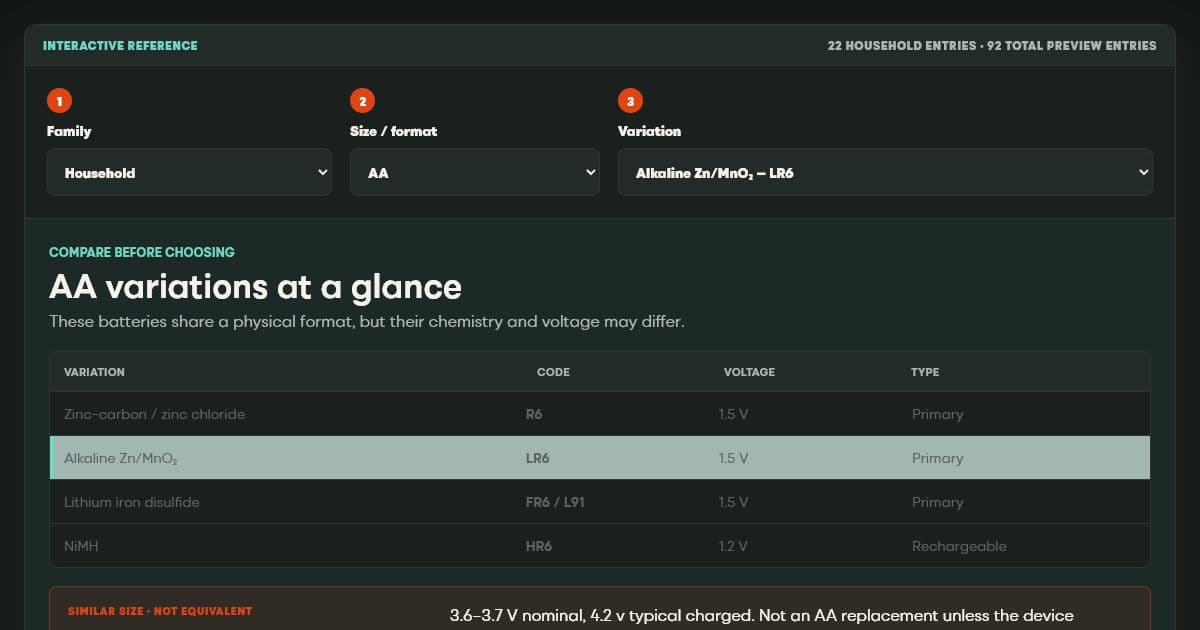
Compare before choosing
AA variations at a glance
These batteries share a physical format, but their chemistry and voltage may differ.
| Variation | Code | Voltage | Type |
|---|---|---|---|
Household · AA
LR6
- Size family
- AA
- Technical designation
- LR6
- Chemistry
- Alkaline Zn/MnO₂
- Nominal voltage
- 1.5 V
- Voltage note
- Primary; no recharge
- Dimensions
- Approx. 14.5 × 50.5 mm
- Drain class
- General drain
- Protected / unprotected
- N/A
- General shape
- Cylindrical
Standard alkaline AA.
Basic dimensional reference
LR6
Final Thoughts
What began as a simple battery-storage project became a study of chemistry codes, shape classifications, dimensional systems, legacy size numbers, manufacturer aliases, and electrical compatibility. That is the rabbit hole behind Cellarium.
A name such as CR2032, LR6, SR626, or 21700 may look like an arbitrary product code at first. But once the system is decoded, the name begins to communicate real engineering information.
Sometimes the dimensions appear almost directly in the number, sometimes they are compressed into shorthand, and sometimes the number points only to a table in a standard. Several entirely different chemistries may also occupy the same physical space.
You may have seen the widely repeated claim that a single mercury-containing button cell can contaminate up to 600,000 litres of water. Modern consumer cells are not all mercury batteries, so that figure should not be treated as a universal measure of today’s batteries. But the broader lesson survives the old example: a cell does not become environmentally insignificant simply because it is small, especially when millions of them are discarded.
As battery casings deteriorate, carelessly discarded cells can release corrosive electrolytes and metals into soil and water. Lithium-based batteries introduce another danger because they can ignite when crushed, punctured, or damaged in household waste and recycling machinery. The amount of hazardous material in one cell may be limited, but the cumulative burden of millions of discarded batteries is not.
Approved battery-collection and recycling programs keep these cells out of landfills and allow useful materials—including steel, zinc, nickel, cobalt, lithium, and manganese—to be recovered where the chemistry and recycling process permit it. Recovery also reduces the demand for additional raw-material extraction. For the sake of the planet, used batteries should never be placed in general waste, burned, buried, or abandoned outdoors. Follow local guidance for protecting exposed terminals, particularly on lithium and 9-volt batteries, and take every used cell to an authorised battery collection point.
That is why the final rule is not simply:
“Does it fit?”
The correct questions are:
Does it fit mechanically?
Does it match electrically?
Is it suitable for the device and the application?
Because engineering is not a guessing game.