
Blog
Electroplating Amp-Hour Calculations: Track Bath Use and Maintenance
Learn how to calculate electroplating amp-hours, track cumulative bath use, estimate consumption, and apply supplier-defined replenishment rates safely.
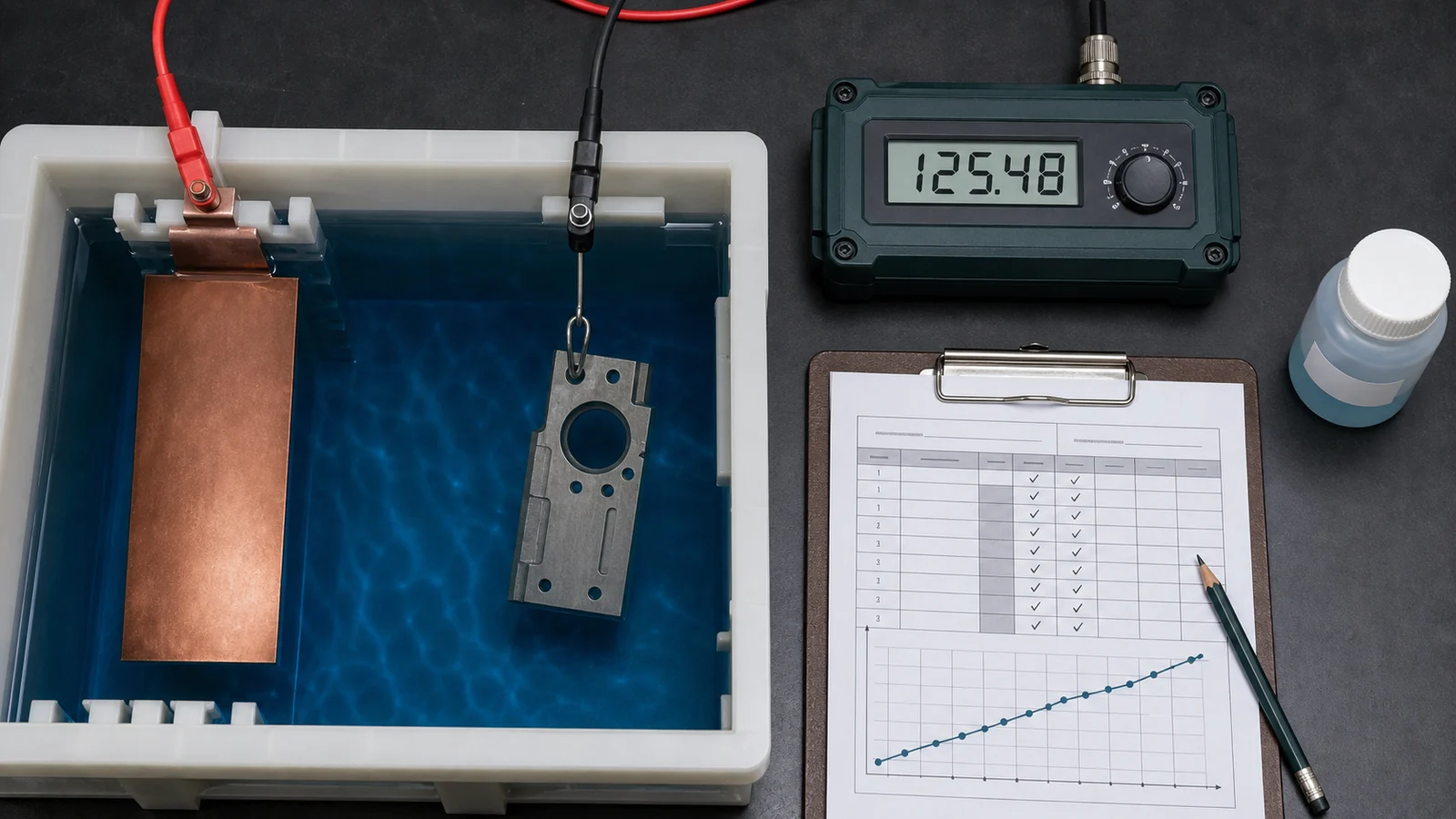
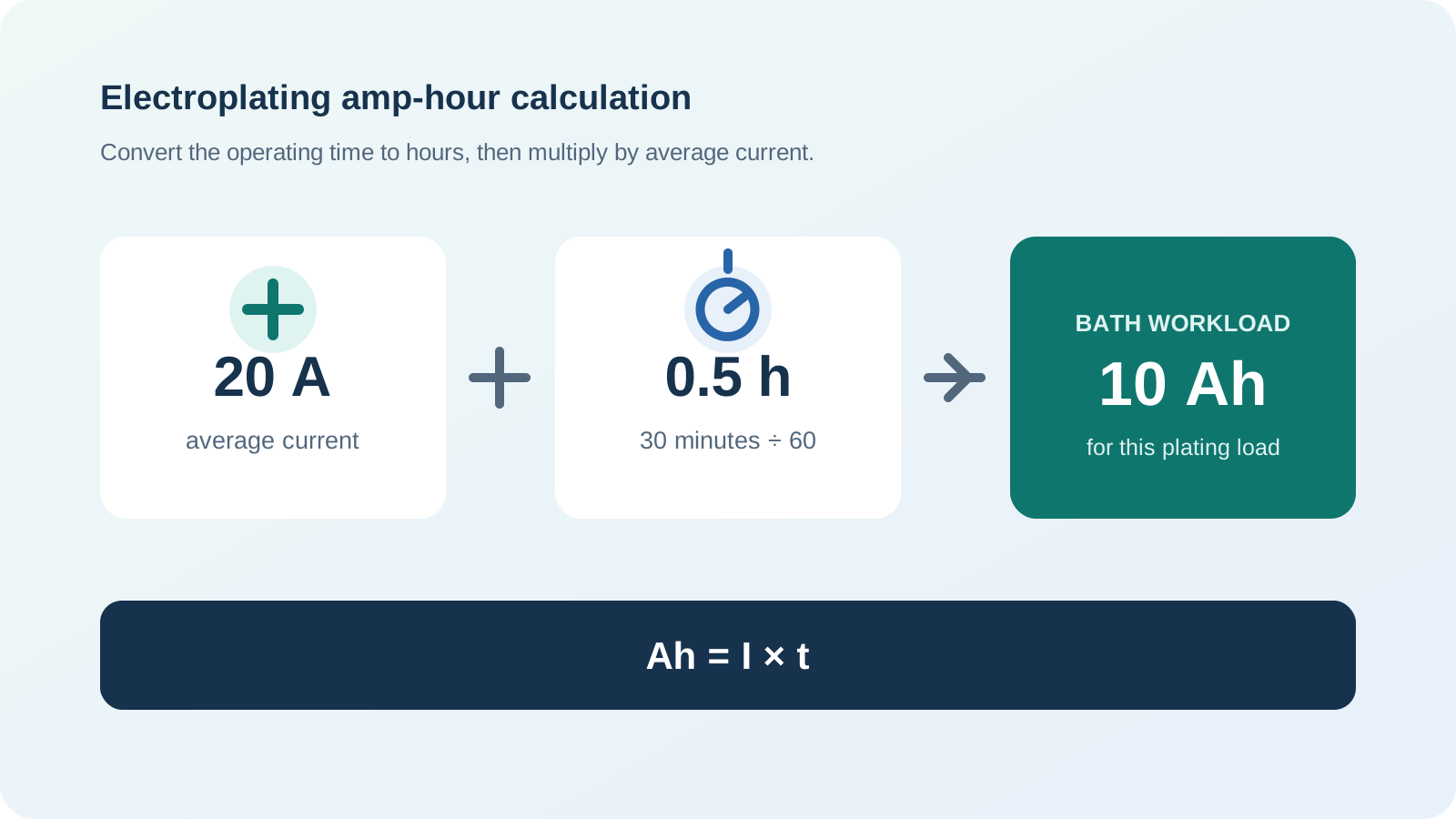
For an electroplating amp hour calculation, multiply current in amperes by operating time in hours:
Amp-hours = Current × Time
Ah = I × t
A bath operating at 20 A for 30 minutes accumulates 10 Ah. If current changes during the plating cycle, calculate each interval separately and add the results. Cumulative amp-hours can then support replenishment, analysis, treatment, and maintenance schedules specified for the particular plating process.
Do not add chemicals solely from a generic amp-hour rate. Use only the replenishment rate and control procedure specified for the exact bath, and confirm bath condition with the analytical or testing method required by the process supplier.
Key principle
Amp-hours tell you how much electrical work the bath has performed; analysis and testing tell you what condition the bath is in.
EPA electroplating documentation identifies rectifier amp-hours as a measurable operating record. Commercial process literature, including Technic's electrolytic copper overview, also uses amp-hour consumption as one input for certain proprietary replenishment systems.
What is an amp-hour in electroplating?
An ampere, or amp, measures the rate of electrical current.
An amp-hour, abbreviated Ah, measures current accumulated over time.
One amp-hour can therefore represent any current-and-time combination whose product equals one:
- 1 A for 1 hour = 1 Ah
- 2 A for 30 minutes = 1 Ah
- 10 A for 6 minutes = 1 Ah
In electrical-charge terms:
1 Ah = 3,600 C
because one ampere is one coulomb per second and one hour contains 3,600 seconds.
Amp-hours are particularly useful in electroplating because clock time alone does not describe the workload placed on a bath.
Consider two tanks that each operate for one hour:
- Tank A operates at 5 A: 5 Ah
- Tank B operates at 50 A: 50 Ah
Both ran for the same amount of time, but the second bath experienced ten times the electrical throughput.
Amp-hours combine current and operating duration into one production measure, allowing different loads, part sizes, plating times, and operating periods to be compared on the same basis.
Historical EPA electroplating guidance specifically notes that the numerical product of current and time is measured by an ampere-hour meter and that rectifier amp-hours can support monitoring and record keeping.
How do you calculate electroplating amp-hours?
The basic electroplating amp-hour calculation is:
Ah = I × t
Where:
| Symbol | Meaning | Unit |
|---|---|---|
| Ah | Electrical throughput | amp-hours |
| I | Average plating current | amperes |
| t | Plating time | hours |
If the plating time is recorded in minutes:
t(hours) = t(minutes) ÷ 60
If it is recorded in seconds:
t(hours) = t(seconds) ÷ 3,600
Common time conversions
| Operating time | Hours used in the formula |
|---|---|
| 15 minutes | 0.25 h |
| 30 minutes | 0.50 h |
| 45 minutes | 0.75 h |
| 60 minutes | 1.00 h |
| 90 minutes | 1.50 h |
Ah and A/h are not the same thing
This small notation difference matters.
Ah means amp-hours. It represents accumulated electrical charge.
A/h means amperes per hour. That describes a rate at which current itself changes with time.
For plating-bath usage records, replenishment calculations, cumulative rectifier readings, and most maintenance schedules, the intended unit is Ah, not A/h.
Worked example: constant-current plating
Suppose a load is plated under these conditions:
- Plating current: 18 A
- Plating time: 35 minutes
First convert the time to hours:
35 ÷ 60 = 0.5833 h
Then calculate amp-hours:
18 × 0.5833 = 10.5 Ah
The plating load contributes approximately 10.5 Ah to the bath total.
A bath record might therefore contain:
| Date | Load | Current | Time | Load Ah | Cumulative Ah |
|---|---|---|---|---|---|
| 3 Aug | Load 014 | 18 A | 35 min | 10.5 Ah | 426.5 Ah |
This is one of the advantages of amp-hour tracking: a production run can be reduced to a single electrical-throughput value without losing the relationship between current and time.
How do you calculate amp-hours when plating current changes?
Real plating current does not always remain perfectly constant.
A process may deliberately use several current stages, or current may change because of operating conditions.
For distinct stages, calculate each interval separately:
Total Ah = Σ(Iᵢ × tᵢ)
Suppose a plating cycle consists of:
- 12 A for 20 minutes
- 20 A for 15 minutes
- 8 A for 10 minutes
Stage 1
12 × (20 ÷ 60) = 4.00 Ah
Stage 2
20 × (15 ÷ 60) = 5.00 Ah
Stage 3
8 × (10 ÷ 60) = 1.33 Ah
Add the three stages:
4.00 + 5.00 + 1.33 = 10.33 Ah
The complete variable-current cycle contributes approximately 10.33 Ah.
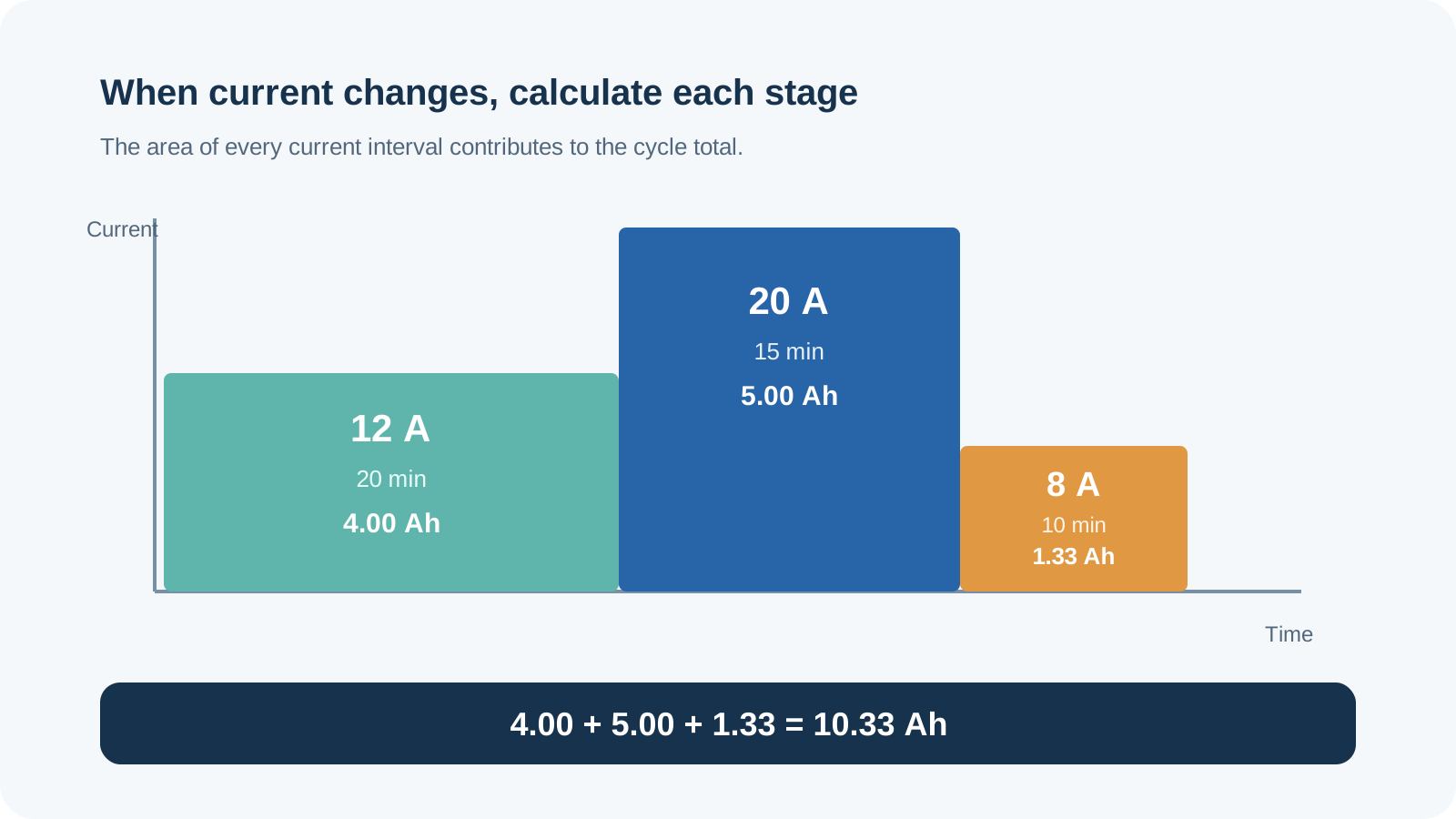
For continuously changing current, the exact mathematical relationship is the area underneath the current-versus-time curve:
Ah = ∫ I(t) dt
when time is expressed in hours.
You do not normally need to perform that integration manually. A rectifier with integrated amp-hour logging, a dedicated amp-hour meter, or sufficiently frequent logged current measurements can perform or approximate it much more reliably.
Can average current be used?
Sometimes.
If only the starting and ending currents are known and the current changed reasonably smoothly and linearly, the approximate average current is:
I(avg) = (I(start) + I(end)) ÷ 2
Then:
Ah ≈ I(avg) × t
For example, if current gradually increases from 10 A to 14 A during a 30-minute run:
I(avg) = (10 + 14) ÷ 2 = 12 A
Ah ≈ 12 × 0.5 = 6 Ah
The estimated throughput is approximately 6 Ah.
This method should be treated as an approximation.
Do not simply average the starting and ending currents when:
- Current fluctuates irregularly
- The rectifier switches off during part of the cycle
- Several intentional current stages are used
- Pulse or pulse-reverse plating is being used
- Accurate replenishment records are required
- Current changes substantially during the run
In those cases, actual current integration or an amp-hour meter is preferable.
How do you maintain cumulative bath amp-hours?
Individual load amp-hours become much more useful when they are added to a running bath total.
The calculation is:
New cumulative Ah = Previous cumulative Ah + Current load Ah
Suppose the bath already has:
1,240 Ah
The next load contributes:
10.5 Ah
Then:
1,240 + 10.5 = 1,250.5 Ah
The new cumulative bath reading is 1,250.5 Ah.
EPA electroplating guidance explains that current multiplied by time is the value measured by an ampere-hour meter and describes rectifier amp-hours as useful for monitoring and record keeping.
When should the amp-hour counter be reset?
There is no universal reset rule.
Depending on the process-control system, an amp-hour history may be:
- Maintained continuously for the working life of the bath
- Reset after complete bath replacement
- Recorded separately for defined maintenance periods
- Split into production and treatment totals
- Managed according to the chemical supplier's documentation
Partial bath replacement creates an important record-keeping problem.
If 20% of a solution is removed and replaced, the bath is no longer chemically identical to the solution represented by the previous cumulative total—but neither is it a completely new bath.
The same issue occurs with:
- Drag-out losses
- Drag-out recovery
- Solution transfers
- Large water additions
- Concentrated chemical additions
- Carbon treatment
- Partial dumps
- Filtration losses
- Maintenance treatments
For that reason, record the event rather than silently resetting the counter.
A useful bath history should tell you not only the cumulative amp-hours, but also what happened to the solution during that period.
How is amp-hour-based additive replenishment calculated?
Some commercial plating processes specify consumption or replenishment in relation to amp-hours.
The general arithmetic is:
Required addition = Amp-hours accumulated × Supplier replenishment rate
The units must match exactly.
Hypothetical example: mL/Ah
Assume—not as a real process specification—that a fictional supplier instruction states:
- Replenishment rate: 0.12 mL/Ah
- Throughput since the previous controlled addition: 750 Ah
Then:
750 × 0.12 = 90 mL
The arithmetic gives a 90 mL calculated addition.
That does not mean 0.12 mL/Ah is an appropriate dosage for any real electroplating bath. It is an invented value used only to demonstrate the calculation.
Hypothetical example: mL per 1,000 Ah
A process may instead express consumption as:
mL/1,000 Ah
The equation becomes:
Addition = (Accumulated Ah ÷ 1,000) × mL per 1,000 Ah
Using another explicitly fictional example:
- Accumulated usage: 750 Ah
- Supplier-defined example rate: 120 mL/1,000 Ah
(750 ÷ 1,000) × 120 = 90 mL
Again, the calculated result is 90 mL.
Commercial documentation confirms that real proprietary systems can use amp-hour-based replenishment while their additives remain process-specific and analytically controlled. Technic's electrolytic copper overview, for example, describes one-component amp-hour-based replenishment and an analyzable additive system. A separate Technic process application guide shows why the exact control method matters: different components are managed by analysis, Hull-cell tests, bath turnover, or a process-specific amp-hour rate.
Warning: never copy a replenishment rate from another bath
Amp-hour arithmetic is universal. Chemical dosing rates are not.
Only use a replenishment rate specified for the exact proprietary or documented plating process being operated.
Verify additions with the analytical, Hull-cell, CVS, titration, instrumental, or other control method specified for that process where applicable.
Why are generic amp-hour replenishment rates dangerous?
The consumption of a plating additive is influenced by far more than electrical throughput.
An amp-hour replenishment rate can depend on:
- Bath chemistry
- Proprietary additive package
- Rack versus barrel operation
- Current density
- Bath temperature
- Agitation
- Cathode current efficiency
- Anode material
- Soluble versus insoluble anodes
- Drag-out
- Filtration
- Carbon treatment
- Solution losses
- Organic decomposition
- Production mix
- Deposit thickness
- Shutdown history
A rate intended for one acid-copper process therefore cannot simply be transferred to another acid-copper process.
It certainly cannot be transferred from copper to nickel, zinc, chromium, silver, gold, or another plating system.
Even two products that deposit the same metal may use entirely different additive chemistry and process-control methods.
The correct workflow is:
- Identify the exact process.
- Obtain the current technical data sheet.
- Confirm the specified control method.
- Use the stated replenishment units.
- Perform the required bath analysis or test.
- Confirm the chemical identity.
- Calculate the addition.
- Record what was actually added.
Amp-hour tracking supports process control. It does not replace it.
Do amp-hours tell you when a plating bath needs maintenance?
They can help tell you when to check.
They cannot tell you what is wrong.
This distinction is central to using amp-hour records correctly.
A cumulative amp-hour threshold may be used as a trigger for:
- Additive checks
- Supplier-defined replenishment
- Bath analysis
- Hull-cell testing
- Filter inspection
- Filter replacement
- Carbon-treatment review
- Anode inspection
- Anode-bag inspection
- Dummy-plating review
- Preventive maintenance
- Maintenance-log review
EPA printed-wiring-board maintenance guidance, for example, documents electrolytic bath treatments whose duration or extent can be expressed in amp-hours per gallon.
But the amp-hour number itself cannot tell you:
- pH
- Metal-ion concentration
- Conductivity
- Chloride concentration
- Supporting-electrolyte concentration
- Brightener balance
- Organic contamination
- Metallic contamination
- Drag-in contamination
- Additive breakdown
- Anode passivation
- Filter performance
- Deposit stress
- Deposit adhesion
- Thickness uniformity
A bath could have accumulated exactly the expected number of amp-hours and still be outside specification because of contamination, drag-out, incorrect additions, temperature history, poor anodes, or another process variable.
Amp-hours measure bath workload—not bath health.
How are amp-hours related to deposited metal?
Amp-hours also connect directly to Faraday's law.
The familiar mass-deposition equation is:
m = (η × I × t × M) ÷ (n × F)
Where:
- m = deposited metal mass
- η = cathode current efficiency as a decimal
- I = current in amperes
- t = time in seconds
- M = molar mass of the deposited metal
- n = number of electrons transferred per deposited ion
- F = Faraday constant, in coulombs per mole
Use compatible mass units: if M is entered in g/mol, m is calculated in grams; if M is entered in kg/mol, m is calculated in kilograms.
Because:
1 Ah = 3,600 C
the same relationship can be written directly using amp-hours:
m = (η × Ah × 3,600 × M) ÷ (n × F)
This tells us several useful things.
More amp-hours generally mean more deposited metal
If the metal, ionic state, bath efficiency, and other conditions remain the same, doubling the amp-hours approximately doubles the theoretical deposited mass.
Different metals deposit different amounts per amp-hour
The result depends on the metal's molar mass and ionic valence.
An amp-hour of electrical throughput therefore does not correspond to one universal number of grams.
Current efficiency matters
Not all applied electrical charge necessarily becomes deposited metal.
Some current may support hydrogen evolution or other side reactions.
EPA chromium-plating calculations explicitly demonstrate this relationship by connecting surface area, thickness, amp-hours, Faraday's law, and cathode efficiency.
For a deeper explanation of current, time, efficiency, and coating thickness, see calculate plating time and thickness.
Does deposited metal equal the amount removed from the bath?
Not necessarily.
This is where a simple Faraday calculation becomes a material-balance problem.
Baths with soluble anodes
In a process using soluble anodes, metal deposited at the cathode can be partly or substantially replaced by metal dissolving from the anode.
That means:
- Metal leaves solution at the cathode.
- Metal enters solution at the anode.
- The net change in dissolved-metal concentration may be much smaller than the cathodic deposit mass.
The balance will depend on anode efficiency and the exact process chemistry.
Baths with insoluble anodes
With an insoluble anode, deposited metal is not replenished through normal anode dissolution.
The process may therefore require controlled replacement of metal through another chemical source.
Other chemical balances may also shift as the process runs.
The bath is an open material-balance system
Real plating tanks are also affected by:
- Drag-out
- Evaporation
- Rinse-water return
- Water additions
- Chemical additions
- Sampling
- Solution transfer
- Sludge formation
- Side reactions
- Contamination
- Filtration losses
- Maintenance treatments
Consequently:
Theoretical deposited-metal mass is useful for engineering checks, but it is not a universal chemical-replenishment instruction.
This is another reason amp-hours should be paired with analysis rather than treated as a substitute for it.
What do Ah/L and Ah/gal mean?
Some plating maintenance instructions normalize electrical throughput to solution volume.
The common forms are:
Ah/L = Total amp-hours ÷ Bath volume in litres
and:
Ah/gal = Total amp-hours ÷ Bath volume in gallons
Normalization makes it possible to scale a documented treatment to baths of different sizes. Because a US gallon and an Imperial gallon are different volumes, use the gallon definition specified by the supplier or operating procedure and record it in the bath log.
If a process specification gives a treatment target in Ah/L:
Required Ah = Target Ah/L × Bath volume
Hypothetical Ah/L example
Assume a fictional process specification calls for:
- Bath volume: 200 L
- Defined treatment: 0.5 Ah/L
Calculate the required electrical throughput:
200 × 0.5 = 100 Ah
If the documented treatment current is 20 A:
t = 100 Ah ÷ 20 A
t = 5 hours
Under those fictional assumptions, the electrical treatment would require 100 Ah, or 5 hours at 20 A.
The 0.5 Ah/L value is illustrative only.
Actual dummy-plating, purification, or electrolytic-treatment conditions must come from the process documentation. Current density, electrode geometry, temperature, agitation, treatment endpoint, and other conditions can be just as important as total amp-hours.
EPA printed-wiring-board maintenance guidance provides examples of electrolytic contaminant treatment expressed in amp-hours per gallon, demonstrating why this normalized unit appears in plating practice.
What should an electroplating amp-hour log contain?
A useful bath log should connect electrical throughput to the process conditions and maintenance events that occurred around it.
Consider recording:
- Date and time
- Bath or tank identifier
- Rectifier identifier
- Part or load identifier
- Rack or barrel process
- Plated surface area
- Starting current
- Average current
- Ending current
- Plating time
- Load amp-hours
- Cumulative amp-hours
- Bath temperature
- pH where relevant
- Additive additions
- Metal-salt additions
- Water additions
- Bath-volume changes
- Analytical results
- Hull-cell results
- Maintenance operations
- Operator initials
- Defects
- Current interruptions
- Other observations
A compact operating log might look like this:
| Date | Load | Average current | Time | Load Ah | Cumulative Ah | Addition or test | Result |
|---|---|---|---|---|---|---|---|
| 3 Aug | Rack 014 | 18 A | 35 min | 10.5 | 1,250.5 | Hull cell | Acceptable |
The important value is not merely the cumulative number.
The history around that number allows the operator to answer questions such as:
- When was the last analysis?
- How many amp-hours have passed since the last replenishment?
- Was a large solution addition made?
- Did deposit quality change after maintenance?
- Has production chemistry changed?
- Did a defect begin after a particular operating event?
This is where a simple electrical counter becomes useful engineering documentation.
What can amp-hours reveal—and what still requires analysis?
| Amp-hour records can help quantify | Amp-hours cannot directly determine |
|---|---|
| Electrical throughput | pH |
| Load-by-load bath usage | Metal concentration |
| Cumulative rectifier use | Contaminant concentration |
| Supplier-defined replenishment intervals | Brightener concentration |
| Supplier-defined maintenance triggers | Chloride or supporting electrolyte |
| Approximate theoretical deposited mass | Anode condition |
| Normalized Ah/L or Ah/gal | Deposit stress |
| Production workload trends | Adhesion |
| Electrical-treatment progress | Minimum local thickness |
| Usage since the previous maintenance event | Overall bath health |
This distinction prevents a common process-control mistake: confusing an easily measured production variable with a complete diagnostic measurement.
Common electroplating amp-hour calculation mistakes
Using minutes as though they were hours
This is probably the easiest way to make a 60× error.
For 30 minutes:
30 min = 0.5 h
not 30 hours.
Confusing Ah with A/h
Ah is accumulated electrical charge. A/h is a current-change rate.
They are different units.
Using peak current instead of average current
If the current moves between 10 and 20 A, simply using the 20 A peak exaggerates throughput unless the process actually operated at 20 A for the whole cycle.
Ignoring interruptions
If the rectifier is off for ten minutes, that interval contributes zero plating amp-hours.
Failing to separate multiple current stages
Calculate each stage independently whenever current deliberately changes.
Assuming the rectifier setpoint equals actual current
Record actual delivered current where possible. Loose contacts, power-supply limitations, control behavior, or process changes can make the measured value differ from the intended setting.
Missing a production load
Cumulative maintenance records become unreliable if individual loads are not recorded consistently.
Double-counting a batch
The opposite error is equally damaging. Make sure one load cannot enter the cumulative record twice.
Resetting the counter without recording why
A reset destroys the bath history unless the previous reading and reason for reset are preserved.
Mixing mL/Ah with mL/1,000 Ah
These units differ by a factor of 1,000.
Always write the full unit next to the supplier rate.
Applying a rate to the wrong bath
A proprietary additive-consumption rate belongs to that process.
Do not transfer it to another bath because the plating metal happens to be the same.
Treating theoretical deposited metal as confirmed solution depletion
Soluble anodes, drag-out, additions, and other material flows prevent that assumption from being universally valid.
Using amp-hours instead of chemical analysis
Amp-hours can tell you when a scheduled check is due.
They cannot tell you what the analysis result will be.
Complete operational amp-hour example
Consider a bath with these records:
Previous cumulative total: 2,840 Ah
Two new loads are processed:
- Load 1: 30 A for 40 minutes
- Load 2: 18 A for 25 minutes
For demonstration only, assume a fictional replenishment rate of:
0.08 mL/Ah
The replenishment interval being evaluated includes only these two loads.
Load 1
30 × (40 ÷ 60) = 20 Ah
Load 2
18 × (25 ÷ 60) = 7.5 Ah
Total new bath usage
20 + 7.5 = 27.5 Ah
Updated cumulative bath total
2,840 + 27.5 = 2,867.5 Ah
Hypothetical replenishment calculation
27.5 × 0.08 = 2.2 mL
Result
The two plating loads contribute 27.5 Ah, bringing the bath's cumulative total to 2,867.5 Ah.
At the fictional example rate, the arithmetic produces a 2.2 mL calculated addition.
That does not mean 2.2 mL should automatically be added. An actual chemical addition should be made only if the exact bath documentation specifies that component, replenishment rate, interval, and control procedure—and after any required analysis or verification has been performed.
A practical bath-maintenance workflow
A disciplined amp-hour workflow can be kept straightforward:
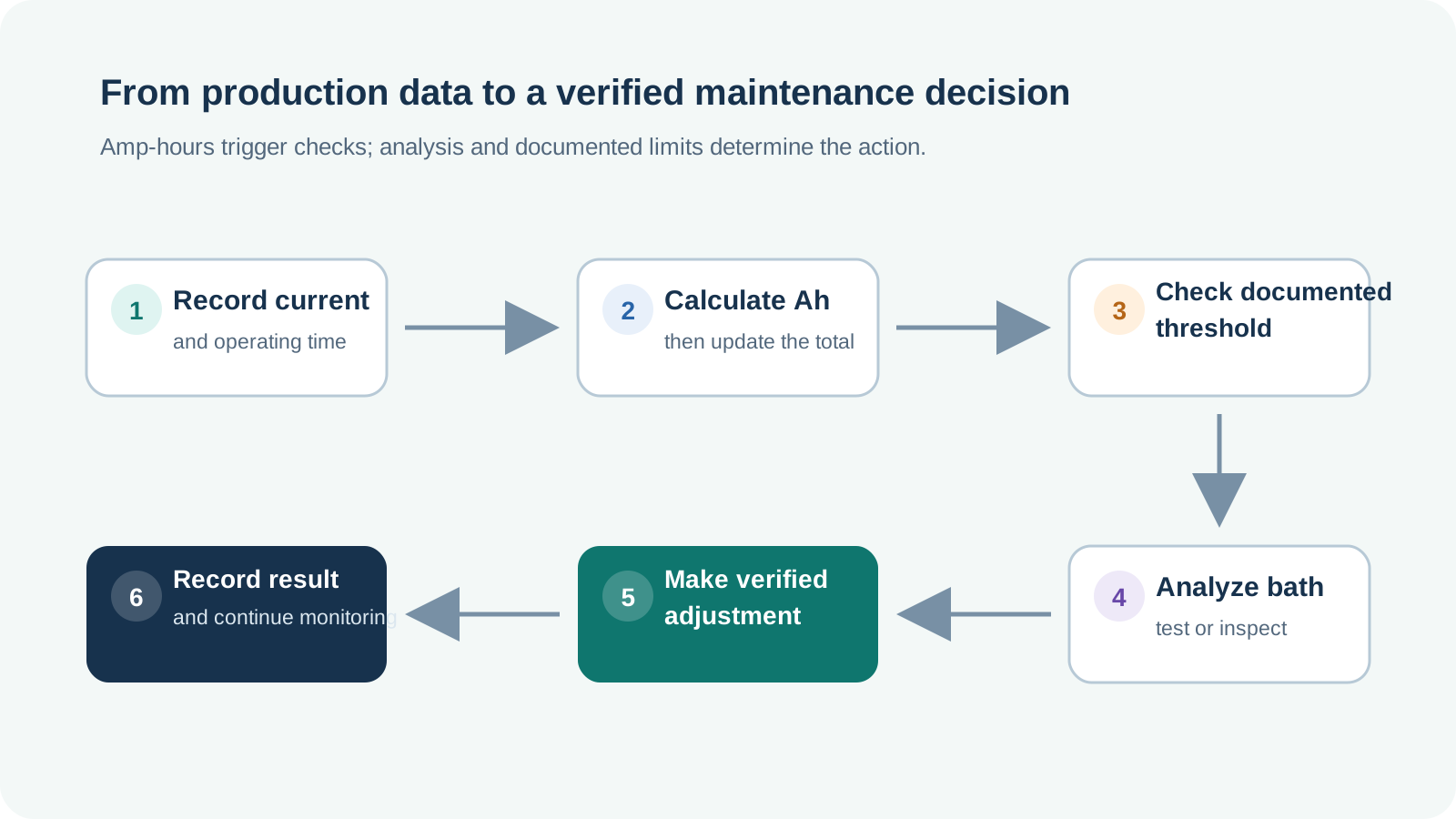
- Record the bath's starting cumulative amp-hour reading.
- Record actual current and operating time for each load.
- Convert minutes or seconds into hours.
- Calculate load amp-hours.
- Add the result to the cumulative bath total.
- Check whether a documented analysis, replenishment, or maintenance threshold has been reached.
- Perform the specified test, inspection, or analysis.
- If an addition is required, identify the exact chemical and supplier-defined rate.
- Confirm that the units match.
- Calculate the required quantity.
- Verify the quantity before adding anything to the bath.
- Add the chemical according to the approved operating and safety procedure.
- Record the addition, analysis result, operator, and bath condition.
- Continue monitoring deposit quality.
- Investigate deviations rather than automatically compensating with more chemical.
Before handling plating chemicals, consult the current Safety Data Sheet and process instructions. Use suitable personal protective equipment, ventilation, labelled containers, spill controls, and applicable waste-disposal procedures.
How PlateLab fits into the workflow
PlateLab is designed to make the electrical and deposition side of electroplating easier to calculate and document.
You can use PlateLab to work with:
- Surface area
- Plating current
- Plating time
- Target thickness
- Current efficiency
- Bath volume
- Copper, nickel, and zinc plating conditions
- Guided plating records
If you need to determine current before calculating amp-hours, first calculate the required plating current.
If the objective is to determine how long a particular deposit should take, calculate plating time and thickness.
PlateLab's Bath Efficiency tools can also help you understand cathode current efficiency by comparing theoretical deposition with measured thickness or mass.
The existing Guided Plating workflow can record a plating run, while a dedicated amp-hour bath tracker would be a useful future extension of PlateLab.
Such a tool could accept:
- Starting cumulative Ah
- Current
- Time
- Multiple current stages
- Bath volume
- Supplier-defined replenishment rate
- Replenishment-rate unit
Possible units could include:
- mL/Ah
- mL/100 Ah
- mL/1,000 Ah
- Ah/L
- Ah/gal
The output could then include:
- Load Ah
- New cumulative Ah
- Ah/L
- Ah/gal
- Calculated process-specific addition
- Distance to a documented maintenance threshold
- Downloadable bath log
The safety rule would remain unchanged:
PlateLab can perform arithmetic using user-entered process values. It should not prescribe a chemical addition when the bath manufacturer, technical data sheet, analysis, or validated procedure has not supplied that value.
EPA records demonstrate why amp-hour logging is useful as an operating metric, while commercial process documentation demonstrates why the chemistry associated with that metric remains bath-specific.
Assumptions and limitations
Technical review: Ersin Aytaç, creator of PlateLab.
The calculations in this article assume that:
- Current readings are reasonably accurate.
- Time records represent actual energized plating time.
- Replenishment rates, where used, are supplied for the exact process.
- Bath volume is known when using Ah/L or Ah/gal.
- Faraday-law calculations use the correct metal, valence, and efficiency.
- Examples labelled hypothetical are used only to demonstrate arithmetic.
Amp-hour records do not compensate for poor electrical contact, incorrect bath chemistry, inaccurate rectifier readings, unrecorded drag-out, solution transfer, contamination, evaporation, or undocumented additions.
They also do not prove that the deposit meets a thickness, adhesion, appearance, stress, hardness, or corrosion-resistance specification.
Calculation is one part of process control. Measurement and inspection complete it.
Frequently asked questions
What is an amp-hour in electroplating?
An amp-hour measures electrical current accumulated over time. One amp-hour is produced by operating at 1 A for one hour, 2 A for 30 minutes, or another equivalent current-time combination. Electroplaters can use cumulative amp-hours to record bath workload and support process-specific maintenance, analysis, or replenishment schedules.
How do you calculate electroplating amp-hours?
Multiply average current in amperes by plating time in hours:
Ah = A × h
Use the measured or representative average delivered current, not merely a peak value or an unverified rectifier setpoint. For example, 20 A applied for 30 minutes uses 0.5 hours:
20 × 0.5 = 10 Ah
The load therefore contributes 10 Ah.
How do you calculate amp-hours when current changes?
Divide the plating cycle into intervals. Multiply the current by the duration of each interval, then add the individual amp-hour results. If current varies continuously, a rectifier-integrated amp-hour meter or logged current integration is preferable to estimating the entire cycle from one current reading.
Can amp-hours tell me when to add brightener?
Only if the exact plating-process supplier specifies an amp-hour-based replenishment rate and its control conditions. Many processes also require chemical analysis, Hull-cell testing, CVS, or another bath-control method. Do not use a generic brightener consumption rate or transfer a rate from another plating bath.
Should I reset the amp-hour meter after replenishment?
Not automatically. Some operations maintain a lifetime cumulative bath total, while others track defined replenishment or maintenance intervals separately. Follow the documented process-control system and record every reset, bath replacement, transfer, partial solution change, and major maintenance operation. Preserve the previous reading so the bath history remains traceable.
Do amp-hours measure bath condition?
No. Amp-hours measure electrical throughput. They do not directly measure pH, metal concentration, additive balance, contamination, conductivity, drag-out, anode condition, deposit stress, adhesion, or thickness distribution. Use the amp-hour total alongside the bath's specified analytical and inspection procedures. Analysis and testing determine whether the bath remains within its documented operating limits.
What does amp-hours per gallon mean?
Ah/gal normalizes electrical throughput or a specified treatment by bath volume. If a documented process calls for 2 Ah/gal and the bath contains 50 gallons, the total electrical requirement would be:
2 × 50 = 100 Ah
The actual Ah/gal value must come from the specific bath procedure.
Can amp-hours estimate how much metal was plated?
Yes, theoretically. Faraday's law relates electrical charge to deposited-metal mass. Because one amp-hour equals 3,600 coulombs, accumulated Ah can be converted into theoretical deposited mass using the metal's molar mass, valence, and cathode current efficiency. That mass does not automatically equal the amount of metal that should be added to the bath.
Final checklist
Before relying on an amp-hour bath record:
- Record actual current.
- Record actual energized time.
- Convert time to hours.
- Calculate Ah for every load.
- Separate different current stages.
- Update the cumulative total.
- Record solution additions and losses.
- Record bath transfers and partial replacements.
- Use only supplier-defined replenishment rates.
- Match replenishment-rate units exactly.
- Perform required bath analysis and testing.
- Never treat Ah as a direct measurement of chemical composition.
- Use Faraday's law only with the correct efficiency, metal, and valence.
- Verify deposit quality independently.
- Preserve the historical record when counters are reset.
The basic calculation could hardly be simpler:
Ah = I × t
Using the result correctly requires more discipline.
Calculate amp-hours to measure bath workload; combine that result with analysis, testing, inspection, and documented process limits to make maintenance decisions.
Technical references
- US Environmental Protection Agency, Development Document for the Copper, Nickel, Chromium and Zinc Segment of the Electroplating Point Source Category — defines current multiplied by time as the quantity measured by an ampere-hour meter and discusses rectifier amp-hour records.
- US EPA, Printed Wiring Board Pollution Prevention and Control Technology Analysis — documents electroplating bath maintenance and electrolytic treatment expressed in amp-hours per gallon.
- US EPA, Procedures for Establishing Emissions for Early Reduction Compliance Extensions — connects amp-hours, surface area, thickness, Faraday's law and cathode efficiency in chromium electroplating calculations.
- Technic, Electrolytic Copper — commercial example of proprietary amp-hour-based replenishment combined with analytical process control.
- Technic, LED Substrate Plating Process Application Guide — demonstrates that replenishment methods and rates are component- and process-specific.
- PlateLab and Attalos Guided Plating documentation — practical calculation and record-keeping context for plating current, time, efficiency, surface area, bath volume and process conditions.