
Blog
How Much Metal Can a Nickel Plating Solution Deposit?
Calculate dissolved nickel inventory, nickel deposited per amp-hour, coating mass per part, and practical bath capacity while accounting for soluble-anode replenishment and process-control limits.
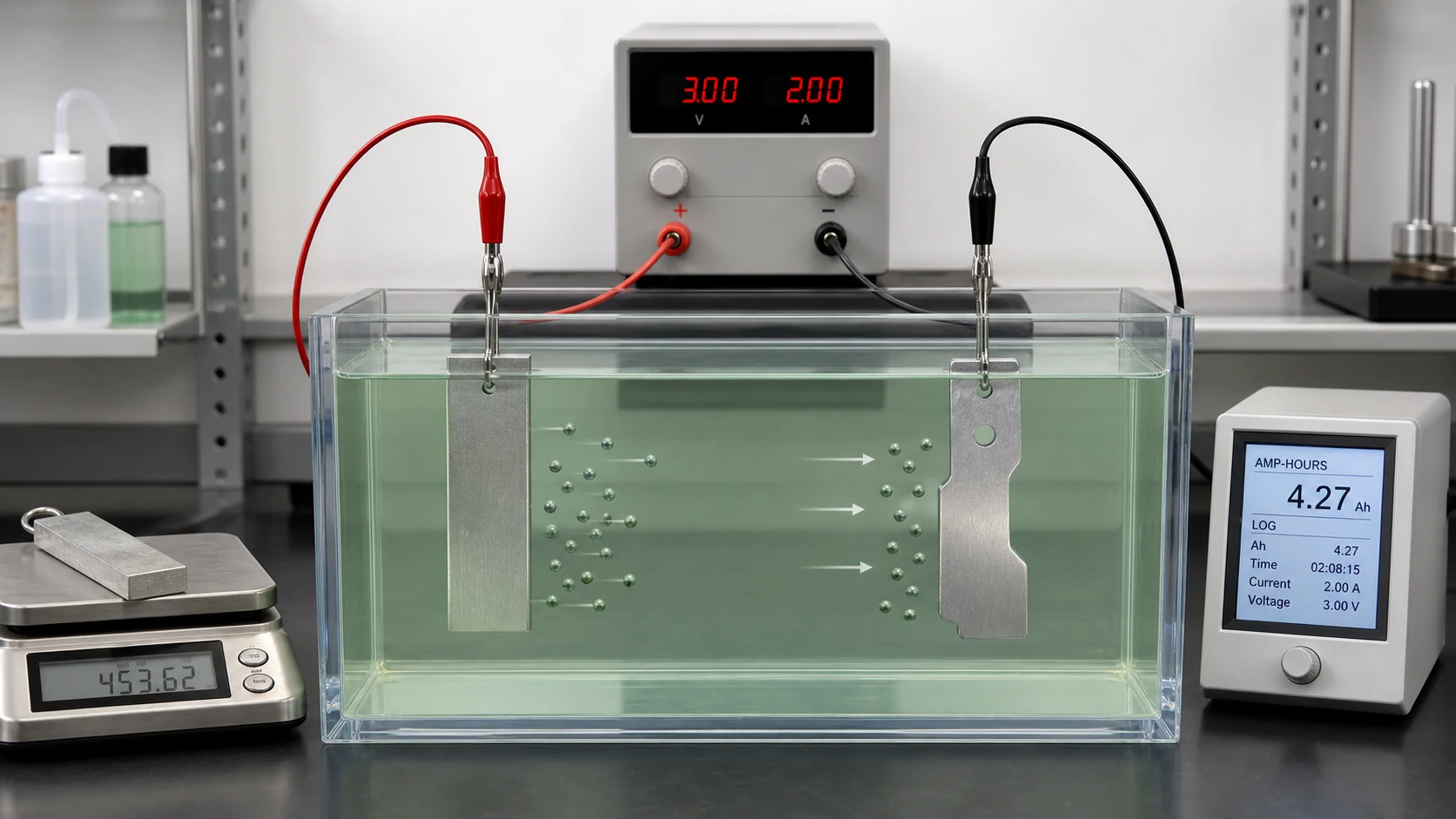
The amount of nickel initially present in a plating solution is calculated by multiplying the working solution volume by its elemental nickel concentration:
Nickel inventory (g) = Bath volume (L) × Elemental nickel concentration (g/L)
For example, 10 L of solution containing 75 g/L of total elemental nickel contains 750 g of dissolved nickel.
That does not mean the bath can plate only 750 g of nickel during its life. In an electrolytic nickel process using soluble anodes, nickel dissolves from the anodes as nickel is deposited at the cathode. A well-operated process can therefore deposit far more nickel over its lifetime than was present in the original solution.
Initial nickel inventory is not lifetime bath capacity.
A practical bath must also not be operated down to zero nickel. Concentration, pH, supporting chemistry, additives, contaminants, anode behaviour, filtration and deposit quality must remain within the operating limits specified for the process.
Nickel-plating bath capacity at a glance
The phrase nickel bath capacity can describe several different quantities.
| Quantity | What it means | What it does not mean |
|---|---|---|
| Initial nickel inventory | Elemental nickel currently dissolved in the working solution | Lifetime production capacity |
| Theoretical one-time reservoir | Nickel initially present if no nickel enters the bath | Safe operating depletion |
| Allowable depletion | Nickel that could be removed before a defined lower control limit | A universal limit for every bath |
| Theoretical deposition | Nickel predicted from current, time and efficiency | Guaranteed measured deposit |
| Lifetime production capacity | Total nickel plated during the useful life of a maintained bath | Starting nickel mass |
| Part capacity | Number of parts corresponding to a defined deposited mass | Parts a bath can plate before replacement |
This distinction matters because “How much nickel can my bath deposit?” has different answers depending on which capacity is being discussed.
How do you calculate how much nickel is in a plating bath?
Use:
mNi = V × CNi
Where:
| Symbol | Meaning | Unit |
|---|---|---|
| mNi | Elemental nickel mass | g or kg |
| V | Working bath volume | L |
| CNi | Elemental nickel concentration | g/L |
Example: 10-litre bath
For a 10 L bath containing 75 g/L elemental nickel:
mNi = 10 L × 75 g/L = 750 g Ni
Example: 400-litre production bath
For a 400 L bath containing 70 g/L elemental nickel:
mNi = 400 L × 70 g/L = 28,000 g = 28 kg Ni
The US EPA AP-42 electroplating reference lists total nickel concentrations from approximately 45 to 86.4 g/L across the nickel-plating formulations in its summary table. These are reference examples, not universal operating specifications; use the actual specification and analysis for your process.
Nickel concentration and nickel-salt concentration are not the same
A bath specification might state:
- 75 g/L elemental nickel
- 300 g/L nickel sulfate hexahydrate
- 45 g/L nickel chloride hexahydrate
- A combination of several nickel salts
Those values cannot be substituted for one another directly. A nickel salt contains nickel plus the other atoms in the compound.
The general conversion is:
Elemental Ni mass = Compound mass × (Ni molar mass ÷ Compound molar mass) × Number of Ni atoms per formula unit
The NIST isotopic-composition table for nickel gives a standard atomic weight of 58.6934.
Why hydration state matters
Nickel salts are frequently supplied as hydrated crystals, such as nickel sulfate hexahydrate or nickel chloride hexahydrate. The water molecules form part of the compound's molar mass and therefore change the percentage of the product that is nickel.
Before converting a nickel salt to elemental nickel, identify:
- The exact chemical formula
- The hydration state
- The product assay or purity
- Whether the supplier reports concentration as salt or elemental nickel
For actual bath make-up, use the product technical data sheet and certificate of analysis rather than relying only on a generic chemical name.
Worked example: nickel sulfate hexahydrate
Nickel sulfate hexahydrate, NiSO4·6H2O, has an approximate molar mass of 262.84 g/mol. Nickel contributes approximately 58.69 g/mol.
Nickel mass fraction = 58.69 ÷ 262.84 = 0.2233, or 22.33%
For a hypothetical solution containing 300 g/L NiSO4·6H2O:
Elemental Ni = 300 g/L × 0.2233 ≈ 67.0 g/L Ni
So 300 g/L of nickel sulfate hexahydrate corresponds to approximately 67 g/L of elemental nickel.
This is a chemical-conversion example, not a bath make-up recommendation.
If the solution contains another nickel-bearing compound, calculate its elemental nickel contribution separately and add the results.
How much nickel is deposited per amp-hour?
Electrolytic nickel normally deposits from divalent nickel ions:
Ni²⁺ + 2e⁻ → Ni
Faraday's law gives deposited mass as:
m = (η × I × t × M) ÷ (n × F)
Where:
| Symbol | Meaning |
|---|---|
| m | Deposited nickel mass |
| η | Cathode current efficiency as a decimal |
| I | Current in amperes |
| t | Time in seconds |
| M | Nickel molar mass |
| n | Electrons transferred per nickel ion, equal to 2 |
| F | Faraday constant |
The NIST 2022 CODATA constants give the Faraday constant as 96,485.33212… C/mol. Since 1 Ah equals 3,600 C, nickel's theoretical deposition at 100% cathode efficiency is approximately:
1 Ah ≈ 1.095 g Ni
The convenient working equation is:
Deposited Ni (g) ≈ 1.095 × η × Ah
At an assumed 95% cathode efficiency:
1.095 × 0.95 ≈ 1.04 g Ni/Ah
The EPA AP-42 reference reports 93–97% cathode efficiency for the nickel-plating conditions it summarizes. The Nickel Institute's Nickel Plating Handbook describes a broader practical range and notes that efficiency depends on the solution and operating conditions. Use a documented or measured value for the actual bath.
Worked example: nickel deposited by 100 Ah
For 100 Ah at an assumed 95% efficiency:
Deposited Ni = 1.095 × 0.95 × 100 ≈ 104.0 g
This is theoretical cathodic nickel deposition corrected by the assumed efficiency. It is not automatically the net decrease in dissolved nickel concentration, the required nickel-salt addition, a measurement of drag-out, or proof of actual coating thickness.
In a soluble-anode bath, some or all of that nickel may be replaced by anodic dissolution during the same production period. Reconcile the estimate with coating-thickness or weight-gain measurements, bath analysis, anode consumption and operating records.
How many amp-hours are needed to deposit a known nickel mass?
Reverse the equation:
Ah = Deposited Ni (g) ÷ (1.095 × η)
For 500 g of deposited nickel at an assumed 95% cathode efficiency:
Ah = 500 ÷ (1.095 × 0.95) ≈ 481 Ah
For a deeper explanation of electrical-throughput records, see Electroplating Amp-Hour Calculations: Track Bath Use and Maintenance.
How much nickel could a bath lose before reaching a lower control limit?
This calculation is useful only when a legitimate operating range has already been defined for the specific process.
Suppose, purely as a hypothetical example:
- Bath volume: 10 L
- Starting nickel concentration: 75 g/L
- Fictional lower control limit: 70 g/L
The allowed concentration change is 5 g/L. Across 10 L:
Allowable nickel change = (75 − 70) g/L × 10 L = 50 g Ni
If no nickel entered from anodes or additions, and cathode efficiency were 95%:
Ah = 50 ÷ (1.095 × 0.95) ≈ 48.1 Ah
Under those deliberately simplified assumptions, approximately 48 Ah would deposit 50 g of nickel and mathematically move the bath from 75 to 70 g/L. The 70 g/L limit is fictional and must not be treated as a recommendation for an actual bath.
Why soluble nickel anodes change the capacity calculation
A conventional electrolytic nickel system is not simply a container of nickel ions that slowly empties.
Soluble nickel anode → Ni²⁺ enters solution → Ni²⁺ deposits at cathode
At the cathode, nickel ions leave the solution and become metallic coating. At the soluble anode, metallic nickel is oxidized and enters the electrolyte as nickel ions.
EPA nickel-plating guidance describes how soluble anodes help replace nickel deposited at the cathode. The Nickel Institute handbook similarly explains that anode efficiency may approach 100% under controlled conditions while cathode efficiency is somewhat lower.
This means a bath beginning with 750 g of dissolved nickel may ultimately deposit far more than 750 g during its useful life. The additional nickel enters through soluble anodes and any documented process additions.
Cathode efficiency and anode efficiency are different
Cathode efficiency describes how effectively charge produces nickel metal on the workpiece:
Cathode efficiency = Actual nickel deposited ÷ Theoretical nickel deposition
Anode efficiency describes how effectively anodic current dissolves nickel into the solution.
The two efficiencies do not have to be identical. If anode dissolution exceeds cathodic deposition plus solution losses, nickel concentration may rise. If deposition and losses exceed anode dissolution, it may fall.
A simplified nickel material balance is:
Change in bath nickel = Anode nickel dissolved + Other nickel additions − Cathodic nickel deposited − Drag-out and other nickel losses
This is why amp-hours alone cannot determine the bath's current nickel concentration.
How much nickel does one plated part consume?
If you know surface area and average coating thickness, calculate coating volume and multiply by nickel density:
Coating mass = Nickel density × Plated area × Average thickness
The Nickel Institute's nickel properties reference lists nickel density as approximately 8.90 g/cm³ at 25°C.
Convenient formula for dm² and µm
For surface area in dm² and average thickness in µm:
Deposited Ni (g) ≈ 0.0890 × Area (dm²) × Thickness (µm)
This shortcut estimates average deposited nickel mass.
Worked example: nickel consumption per part
For 2 dm² plated to an average thickness of 20 µm:
Deposited Ni = 0.0890 × 2 × 20 = 3.56 g
Each part carries approximately 3.56 g of nickel, assuming the area and average thickness are accurate.
One kilogram of deposited nickel would therefore correspond mathematically to:
1,000 ÷ 3.56 ≈ 281 parts
That does not mean the bath can plate only 281 parts. It is a mass-to-part conversion. A maintained soluble-anode bath may deposit many multiples of its original dissolved inventory over its life.
Why real nickel consumption differs
The calculation assumes perfectly uniform average thickness. Real current distribution varies: edges and projections may receive more current, while recesses and shielded areas receive less. Meeting a minimum thickness in low-current areas may therefore require an average deposit thicker than the minimum specification.
Production can also consume nickel on racks, auxiliary cathodes, thieves, rejected or reworked parts, and surfaces omitted from the area estimate. Compare calculations with measured production data. How Long Does Electroplating Take? explains average versus local thickness in more detail.
Why a nickel bath cannot deposit every gram it contains
Important limitation
A practical nickel bath must not be operated until its nickel concentration reaches zero.
The solution must remain within the validated operating range for the process. Its useful life depends on nickel concentration together with pH, supporting chemistry, additives, temperature, agitation, anode behaviour, contamination, filtration, drag-out, current density and deposit performance.
Even an accurate total-nickel analysis does not, by itself, show whether mass transport is adequate, additives are balanced, contaminants are present, anodes are active or the part will plate uniformly.
The inventory calculation answers a material quantity question. It does not replace process analysis.
How do you create a nickel material balance?
Over a defined production period:
Closing inventory = Opening inventory + Nickel added + Anode nickel dissolved − Nickel plated − Drag-out and other documented losses
Useful records include:
| Record | Why it matters |
|---|---|
| Working bath volume | Converts concentration to inventory |
| Total nickel analysis | Measures actual solution concentration |
| Nickel-salt additions | Records external nickel input |
| Anode starting and ending mass | Estimates metal dissolved or removed |
| Amp-hours | Estimates cathodic deposition |
| Deposited mass or thickness | Checks the Faraday estimate |
| Drag-out recovery and solution transfers | Tracks nickel leaving or returning |
| Samples, sludge and filter losses | Captures smaller cumulative pathways |
| Analysis date | Connects chemistry with production history |
If calculated closing concentration repeatedly disagrees with laboratory analysis, investigate bath-volume estimates, unrecorded additions or drag-out, solution returned from rinses, efficiency assumptions, anode problems, analytical uncertainty and nickel held in sludge or filter media.
The discrepancy can be useful: a material balance reveals where process records no longer agree with physical reality.
Complete worked nickel-bath scenario
Consider a small bath with:
- Working volume: 20 L
- Total elemental nickel: 75 g/L
- Part area: 1.5 dm²
- Target average thickness: 15 µm
- Assumed cathode efficiency: 95%
- Production run: 100 parts
1. Initial dissolved nickel inventory
20 L × 75 g/L = 1,500 g = 1.50 kg dissolved Ni
2. Nickel deposited on one part
0.0890 × 1.5 × 15 ≈ 2.00 g Ni per part
3. Nickel deposited on 100 parts
2.00 g × 100 ≈ 200 g Ni
4. Theoretical electrical throughput
Ah = 200 ÷ (1.095 × 0.95) ≈ 192 Ah
It would be tempting to subtract 200 g from the starting 1.50 kg and claim that the bath now contains 1.30 kg. That is valid only in the artificial case where no nickel entered from anodes or other sources and no other nickel-related material flow occurred.
In a functioning soluble-anode bath, nickel may simultaneously dissolve from anodes, solution may leave through drag-out or return from recovery, and bath volume may change. The actual concentration must be checked analytically.
Do not automatically subtract cathodic deposition from bath inventory and treat the result as the new nickel concentration.
What each nickel calculation proves
| Calculation | Formula | What it tells you | What it does not prove |
|---|---|---|---|
| Initial nickel inventory | m = V × CNi | Dissolved elemental nickel at that moment | Lifetime bath capacity |
| Nickel from amp-hours | m ≈ 1.095 × η × Ah | Predicted cathodic deposition | Net bath depletion |
| Amp-hours for nickel mass | Ah = m ÷ (1.095 × η) | Electrical-throughput estimate | Bath condition |
| Part coating mass | m = ρ × S × h | Average nickel carried by a part | Minimum local thickness |
| Allowable depletion | ΔC × V | Nickel change across defined limits | Universal safe range |
| Material balance | Opening + inputs − outputs | Expected closing inventory | Replacement for analysis |
Do not confuse electrolytic nickel with electroless nickel
These amp-hour calculations apply to electrolytic nickel plating, which uses an external DC power source and can be analysed using electrical charge and Faraday's law.
Electroless nickel plating uses a chemical reducing agent, does not require cathodic plating current and is commonly managed using bath chemistry, by-product buildup and metal turnovers.
Do not apply the 1.095 g/Ah equation to an electroless nickel bath.
How PlateLab fits into nickel-deposition calculations
PlateLab uses Faraday-based calculations for copper, nickel and zinc plating, including surface area, current, time, target thickness and current efficiency.
For related workflows:
- Calculate plating current from part area.
- Estimate electroplating time and thickness.
- Track cumulative amp-hours.
- Use PlateLab's Bath Efficiency calculator when measured mass or thickness is available.
- Follow the complete process in How to Electroplate with PlateLab.
PlateLab supports the arithmetic and workflow. It does not prescribe nickel-salt additions without the exact bath specification and supporting analysis.
Assumptions and limitations
The worked examples assume:
- Nickel deposits as Ni²⁺
- Nickel molar mass is approximately 58.6934 g/mol
- The Faraday constant is approximately 96,485.33212 C/mol
- Nickel density is approximately 8.90 g/cm³
- Average deposit thickness is uniform where coating mass is calculated
- The stated cathode efficiency represents the process
- Bath volume and elemental-nickel concentration are accurate
- Salt conversions use the exact hydration state shown
They do not automatically account for drag-out, rinse recovery, anode efficiency, additive chemistry, local thickness variation, rejected parts, auxiliary cathodes, sludge, sampling, bath-volume changes or analytical uncertainty.
Treat the results as engineering estimates and check them against production data.
Frequently asked questions
How much nickel is in a nickel-plating bath?
Multiply working bath volume by elemental nickel concentration. A 10 L bath containing 75 g/L elemental nickel contains 750 g of dissolved nickel. This is its current inventory, not necessarily its lifetime deposition capacity.
How much nickel is deposited per amp-hour?
Nickel deposited from divalent ions has a theoretical value of approximately 1.095 g/Ah at 100% cathode efficiency. At an assumed 95% efficiency, the estimate is approximately 1.04 g/Ah.
Can a nickel bath deposit all the nickel dissolved in it?
It should not be operated until its dissolved nickel approaches zero. Concentration must remain within the specified control range. In addition, soluble nickel anodes normally replace much of the nickel deposited at the cathode.
Does nickel-plating solution eventually run out of nickel?
Nickel concentration can fall when cathodic deposition and solution losses exceed anode dissolution and documented additions. In a balanced soluble-anode process, much of the deposited nickel is continually replaced. Analysis determines the actual concentration.
How do soluble nickel anodes replenish the solution?
Nickel metal at the anode oxidizes into nickel ions while nickel ions at the cathode gain electrons and become metallic coating. These flows may be approximately balanced in a controlled process.
How can I estimate nickel consumption per part?
Multiply plated area by average thickness and nickel density. For area in dm² and thickness in µm, deposited nickel mass is approximately 0.0890 × area × thickness, in grams.
Is nickel-sulfate concentration the same as elemental nickel concentration?
No. Nickel sulfate includes sulfate and may include water of hydration. Convert the exact supplied compound to elemental nickel using its formula, hydration state and assay.
Can amp-hours tell me when to add nickel salts?
Not by themselves. Amp-hours estimate theoretical cathodic deposition but do not directly measure bath concentration or account for anode replenishment, drag-out and other material flows. Additions must follow the process-control procedure and bath analysis.
Does this calculation apply to electroless nickel?
No. Electroless nickel uses a chemical reducing agent instead of external plating current, so ordinary amp-hour deposition calculations do not describe its consumption.
Final calculation checklist
Before estimating nickel bath capacity:
- Confirm working bath volume.
- Determine whether concentration is reported as elemental nickel or nickel salt.
- Identify the exact salt and hydration state.
- Convert each nickel-bearing compound separately.
- Use a documented or measured cathode efficiency.
- Track amp-hours when estimating deposited nickel.
- Measure part area and target thickness when estimating nickel per part.
- Record anode mass changes and nickel additions.
- Account for drag-out and solution-volume changes.
- Reconcile calculated inventory with chemical analysis.
- Never treat the entire dissolved inventory as usable depletion.
- Never prescribe nickel-salt additions from amp-hours alone.
- Keep electrolytic and electroless nickel calculations separate.
The key engineering distinction
It is straightforward to calculate how much nickel is in a tank:
Nickel inventory = Bath volume × Elemental nickel concentration
It is also straightforward to estimate how much nickel a measured charge could deposit:
Deposited Ni ≈ 1.095 × Cathode efficiency × Amp-hours
The more important question is what those calculations represent. A tank containing 1 kg of dissolved nickel is not necessarily limited to depositing 1 kg over its life. Soluble anodes can replenish deposited metal, while drag-out, anode behaviour, additions and maintenance continually change the material balance.
Likewise, knowing the theoretical deposited mass does not reveal the bath's present condition. That requires measurement.
A nickel bath's dissolved-metal inventory can be calculated, but its useful production capacity is governed by anode replenishment, material losses, bath chemistry, process control and verified deposit quality—not by starting nickel mass alone.
Technical references
- US EPA, AP-42 Section 12.20: Electroplating
- US EPA, Nickel Plating Industry Practices, Control Technologies and Environmental Management
- Nickel Institute, Nickel Plating Handbook
- Nickel Institute, Key Properties of Nickel
- NIST, Atomic Weights and Isotopic Compositions for Nickel
- NIST, Fundamental Physical Constants