
Blog
Electroplating Efficiency: Theoretical vs Actual Deposit Weight
Calculate electroplating current efficiency by comparing Faraday's theoretical deposit weight with measured mass gain, examples, and troubleshooting.
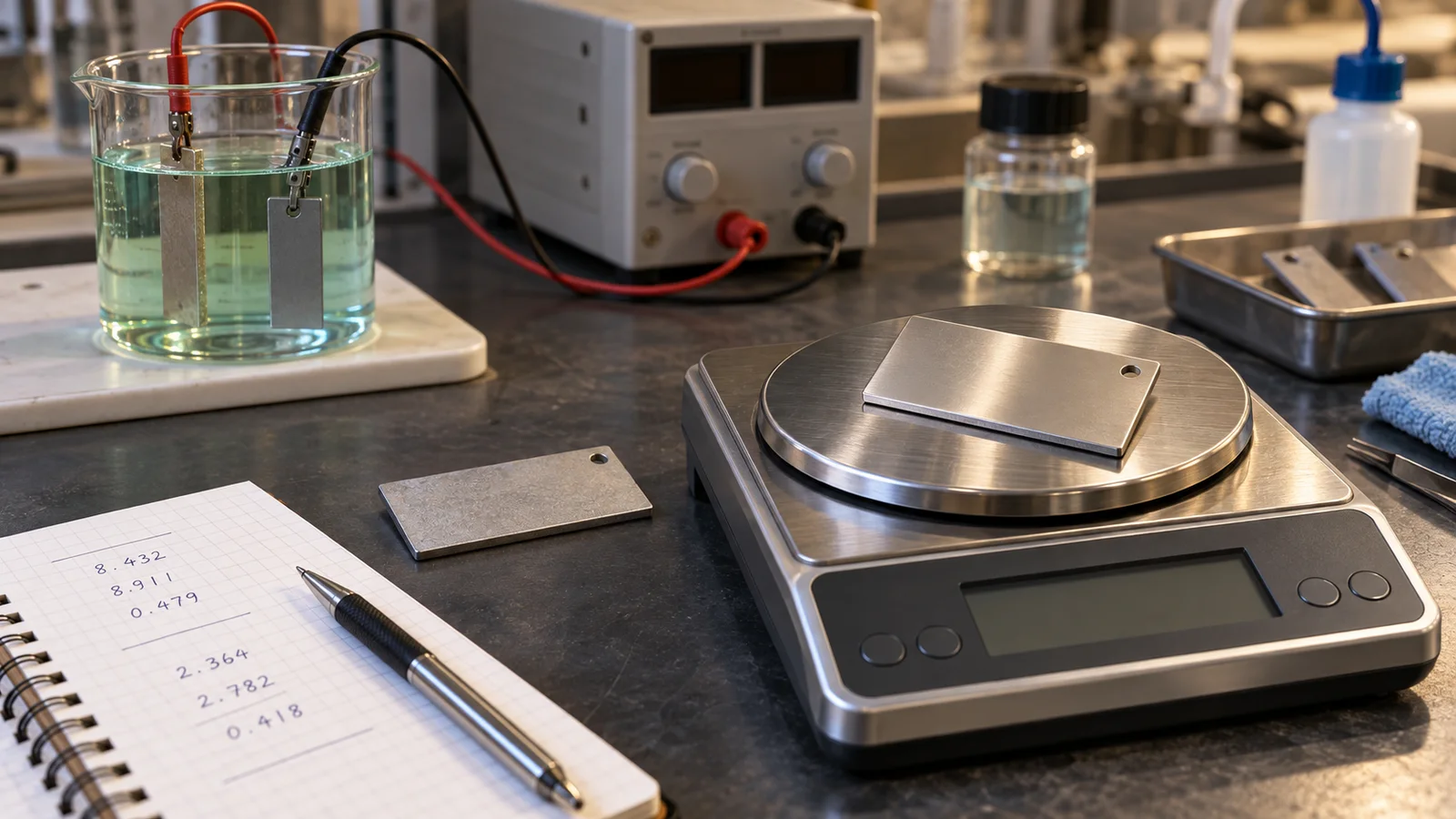
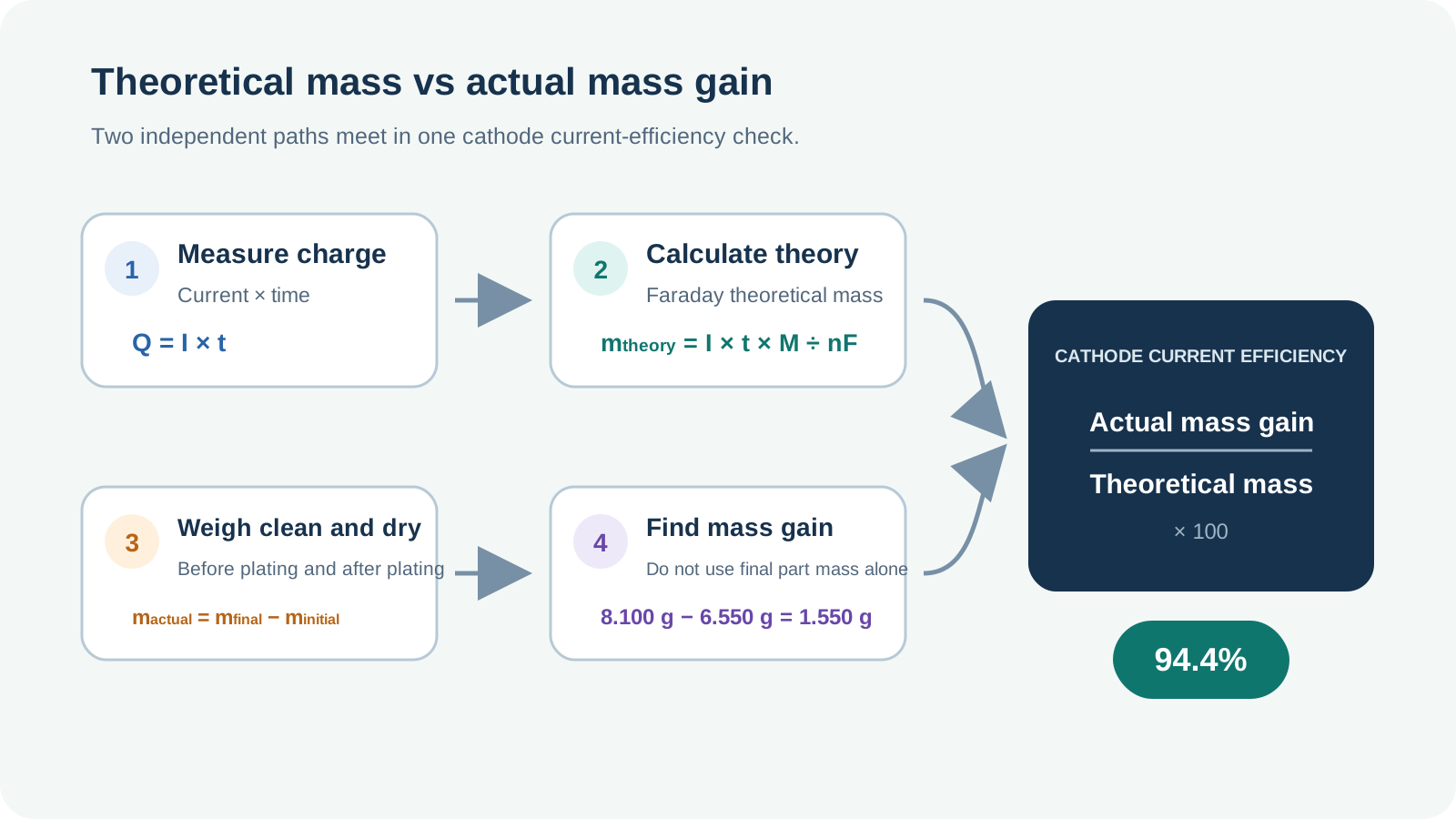
Electroplating current efficiency compares the metal mass actually deposited on a cathode with the theoretical mass predicted from the electrical charge passed through the bath:
Cathode current efficiency (%) = Actual deposited metal mass ÷ Theoretical deposited metal mass × 100
The actual deposited mass is the workpiece's clean, dry final mass minus its clean, dry initial mass. It is not the final total mass of the plated part.
The theoretical mass comes from Faraday's law. If current is constant:
Theoretical deposit mass = (Current × Time × Molar mass) ÷ (Electrons transferred × Faraday constant)
This comparison turns a current-and-time calculation into a practical process check. It can show whether the measured deposit agrees with the ideal electrochemical prediction, but it does not identify a bath problem by itself. Reliable interpretation still requires correct units, the right deposition reaction, measured amp-hours, controlled weighing and knowledge of the actual process.
What does electroplating efficiency mean?
In an ideal calculation, every electron passing through the cathode contributes to depositing the intended metal. Real aqueous plating processes can also support secondary reactions. Hydrogen evolution is a common example: some current may produce hydrogen gas instead of metal. Other reactions and process conditions can also affect how much of the measured charge becomes the target coating.
Cathode current efficiency is the percentage of total cathodic charge represented by the measured target-metal deposit. If a calculation predicts 10.00 g at 100% efficiency and the workpiece gains 9.50 g of the intended metal, the calculated cathode current efficiency is 95.0%.
Theoretical deposit weight is an ideal charge-to-mass prediction. Actual deposit weight is a measurement. Their ratio is useful only when the charge, deposition reaction and mass gain have all been determined correctly.
Although “deposit weight” is the familiar search term, the equations use mass, normally expressed in grams. This guide uses “weight” conversationally and “mass” in calculations.
Current efficiency is not energy efficiency
Voltage does not appear directly in Faraday's mass equation. The ideal deposit mass depends on charge—current multiplied by time. Voltage still matters because it drives current through the cell and affects power and energy consumption, but higher voltage does not automatically deposit more metal when current and time are unchanged.
Current efficiency and energy efficiency answer different questions:
- Current efficiency: What fraction of electrical charge produced the measured target-metal deposit?
- Energy efficiency: How effectively did the process convert electrical energy into useful output?
How do you calculate theoretical electroplating weight?
Faraday's law gives the theoretical metal mass at 100% current efficiency:
m_theoretical = (I × t × M) ÷ (n × F)
| Symbol | Meaning | Unit used here |
|---|---|---|
| m_theoretical | Theoretical deposited metal mass | g |
| I | Actual average cathode current | A |
| t | Plating time | s |
| M | Molar mass of the depositing metal | g/mol |
| n | Electrons transferred per deposited metal atom | dimensionless |
| F | Faraday constant | 96,485.33212 C/mol |
The Faraday constant used here is the NIST 2022 CODATA value. Because one ampere is one coulomb per second, multiplying amperes by seconds gives coulombs.
Ampere-hour form
One ampere-hour equals 3,600 coulombs. When charge is recorded in ampere-hours:
m_theoretical (g) = Ah × 3,600 × M ÷ (n × F)
This form is convenient for production records and connects directly with electroplating amp-hour tracking.
If current changes during the run, do not multiply the final current reading by the total time. Use integrated charge from an amp-hour meter or calculate the charge for each interval:
Total Ah = (I₁ × t₁) + (I₂ × t₂) + ...
with every time interval expressed in hours.
Why the number of electrons matters
The value of n comes from the actual metal-ion reduction reaction. For divalent nickel:
Ni²⁺ + 2e⁻ → Ni
so n = 2. Common Cu²⁺ and Zn²⁺ processes also use two electrons per metal atom:
| Deposition reaction | n | Theoretical mass at 100% efficiency |
|---|---|---|
| Ni²⁺ + 2e⁻ → Ni | 2 | approximately 1.095 g/Ah |
| Cu²⁺ + 2e⁻ → Cu | 2 | approximately 1.186 g/Ah |
| Zn²⁺ + 2e⁻ → Zn | 2 | approximately 1.220 g/Ah |
The values use the CIAAW standard atomic weights for nickel, copper and zinc. They are useful shortcuts only when the stated ionic reaction matches the bath.
For example, a Cu⁺ process uses n = 1, not 2, and has a different theoretical mass per ampere-hour. Never choose the electron count from the metal name alone. Confirm the depositing species and process chemistry.
How do you measure actual deposit weight?
For a simple before-and-after test:
m_actual = m_final,dry − m_initial,dry
Suppose an unplated part weighs 125.000 g and the same part weighs 126.550 g after plating, rinsing and complete drying:
Actual mass gain = 126.550 − 125.000 = 1.550 g
The 1.550 g gain is compared with the theoretical deposit. Dividing 126.550 g by the theoretical deposit would compare the part's substrate mass with a coating calculation and produce a meaningless efficiency value.
The mass-gain method also makes an important assumption: the measured gain substantially represents the intended deposited metal. Retained solution, salts, oxides, co-deposited matter or substrate changes can cause the measured mass change to differ from the mass of pure target metal.
Worked example: theoretical versus actual nickel deposit weight
Consider a nickel-plating test with these recorded values:
| Input | Value |
|---|---|
| Average measured current | 2.00 A |
| Plating time | 45.0 min = 2,700 s |
| Charge | 2.00 A × 0.750 h = 1.500 Ah |
| Nickel molar mass | 58.6934 g/mol |
| Electrons transferred | 2 |
| Initial clean, dry part mass | 125.000 g |
| Final clean, dry part mass | 126.550 g |
Step 1: Calculate theoretical nickel mass
m_theoretical = (2.00 A × 2,700 s × 58.6934 g/mol) ÷ (2 × 96,485.33212 C/mol)
m_theoretical ≈ 1.642 g Ni
The ampere-hour shortcut gives the same result:
1.500 Ah × 1.095 g/Ah ≈ 1.642 g Ni
The Nickel Institute's Nickel Plating Handbook likewise gives approximately 1.095 g of nickel per ampere-hour at 100% current efficiency.
Step 2: Calculate actual mass gain
m_actual = 126.550 g − 125.000 g = 1.550 g
Step 3: Calculate cathode current efficiency
η_cathode = 1.550 ÷ 1.642 × 100 ≈ 94.4%
| Result | Value |
|---|---|
| Theoretical nickel deposit | 1.642 g |
| Measured nickel mass gain | 1.550 g |
| Difference | 0.092 g |
| Calculated cathode current efficiency | 94.4% |
This means approximately 94.4% of the measured charge is represented by the measured nickel mass gain under the stated assumptions. It does not prove that the other 5.6% was consumed by one specific reaction. Additional evidence would be needed to separate hydrogen evolution, measurement error, deposit loss and other possible causes.
For context, the Nickel Institute describes cathode current efficiencies from about 90% to 97% for different nickel solutions and notes that the exact value depends on solution and operating conditions. The US EPA AP-42 electroplating reference summarizes 93–97% for the nickel-plating conditions in its table. These are reference values, not universal control limits. Use the current supplier specification and validated operating history for the actual bath.
How should a plated part be weighed accurately?
A precise equation cannot rescue inconsistent measurements. The initial and final mass values must represent comparable conditions.
Recommended weighing sequence
- Prepare the unplated workpiece. Complete cleaning and any required activation steps that precede plating, then rinse as appropriate.
- Dry it completely. Moisture trapped in holes, threads, seams or porous surfaces can be much heavier than a thin coating.
- Let the part reach a stable condition. Avoid weighing one part hot and the other at room temperature.
- Record the initial mass. Use the same scale and units planned for the final weighing.
- Plate while recording actual current and time. If current varies, integrate charge rather than relying on one display reading.
- Rinse consistently. Remove process solution and soluble residues without losing loosely attached substrate or deposit material.
- Dry fully using a method compatible with the part and coating. Do not use a drying treatment that oxidizes, degrades or removes the deposit.
- Return the part to a comparable temperature and environment. Air currents, vibration and temperature gradients affect sensitive balances.
- Record the final mass. Repeat the weighing until the reading is stable when accuracy matters.
- Subtract initial mass. Only the difference is used as measured deposit mass.
Choose a scale with enough resolution
Scale resolution must be small relative to the expected gain. A scale reading to 0.01 g gives little useful detail for a 0.03 g deposit because uncertainty from two weighings becomes a large fraction of the result. When appropriate, increase the test deposit, use a more capable balance and document repeatability. Do not report more precision than the instruments support; 94.4% may already be more precise than some workshop setups justify.
Why can actual deposit weight be below theoretical weight?
A result below 100% means measured target-metal gain is lower than the ideal charge-based prediction. Check the calculation, measurement and process systematically.
Possible contributors include:
- Cathodic side reactions. Hydrogen evolution or another reduction reaction can consume part of the current.
- Incorrect valence or molar mass. The wrong deposition reaction changes the theoretical electrochemical equivalent.
- Incorrect charge. A power-supply setpoint may not equal actual current, especially if current changes during the run.
- Intermittent electrical contact. Poor rack, hook or workpiece contact can interrupt current at the part.
- Deposit loss. Powdery, burnt, poorly adherent or mechanically damaged coating may be lost during plating, rinsing, drying or handling.
- Substrate loss. Cleaning, pickling or in-process dissolution can remove base material, reducing net mass gain even when metal is deposited.
- Timing and unit errors. Minutes entered as seconds, milliamperes treated as amperes or incorrect decimal placement can dominate the result.
- Bath and operating conditions. Chemistry, pH, temperature, additives, contamination, agitation and current density can influence competing reactions.
- Insufficient weighing resolution. Scale noise can obscure a small deposit.
Shielded areas, recesses and edges influence where metal deposits. They do not automatically reduce total mass efficiency when total cathode current and all deposited mass are measured correctly. Acceptable total weight gain can still hide thin recesses and thick edges.
Can electroplating efficiency appear higher than 100%?
An apparent result above 100% should trigger a review. It does not mean the process created more pure target metal than Faraday's law permits from the measured charge.
Common causes include:
- Residual rinse water or trapped plating solution
- Soluble salt residue left on the part
- Oil, debris or another material added between weighings
- Co-deposition, inclusions, oxides or compounds contributing mass
- A different part temperature or unstable balance conditions
- Scale drift or insufficient resolution
- Incorrect current, time, units, molar mass or valence
- Using final total part mass instead of final-minus-initial mass gain
- Under-recorded amp-hours because current changed or data collection started late
Confirm that the measured gain represents the intended metal and that every input describes the same plating interval.
Is cathode current efficiency the same as bath efficiency?
“Bath efficiency” is often used informally, but it can refer to several different metrics. Name the quantity explicitly when recording or discussing results.
| Metric | Comparison | Question answered |
|---|---|---|
| Cathode current efficiency | Actual target-metal deposit ÷ theoretical Faraday deposit | How much cathodic charge produced the measured deposit? |
| Anode current efficiency | Actual anode dissolution ÷ theoretical dissolution | How effectively did the anode supply metal ions? |
| Thickness ratio | Measured average thickness ÷ predicted or target thickness | Did average coating build match the plan? |
| Material utilization | Metal on acceptable parts ÷ metal consumed or purchased | Where did the metal go? |
| Production yield | Accepted parts ÷ total processed parts | How many parts met requirements? |
| Energy efficiency | Useful output ÷ electrical energy input | How effectively was electrical energy used? |
Cathode and anode current efficiency are not necessarily equal. In a soluble-nickel-anode system, the anode may dissolve nickel at nearly 100% efficiency while cathode efficiency is somewhat lower. That imbalance can slowly increase nickel concentration, although drag-out and other losses may offset it. This is one reason starting nickel inventory is not the same as lifetime nickel-plating capacity.
Mass efficiency versus thickness measurement
Mass gain integrates deposit over the entire part. With plated area and metal density, it can be converted into average thickness:
Average thickness = Deposit mass ÷ (Density × Plated area)
The average does not reveal local distribution. Edges may receive more current while recesses receive less, so correct total mass can coexist with a failed local minimum-thickness requirement.
Use mass gain for total deposited material and current efficiency, thickness measurements for distribution and local conformity, and both when acceptance depends on each.
For the relationship between surface area, current, time and average thickness, see How Long Does Electroplating Take?. For establishing the required current from area and current density, see How to Calculate Electroplating Current from Surface Area.
How can PlateLab help calculate electroplating efficiency?
PlateLab includes a Bath Efficiency workflow for copper, nickel and zinc calculations. In mass mode, enter the metal and bath type, units, initial mass, current and time to calculate the theoretical final mass. Then enter the clean, dry final measured mass to compare measured mass gain with theoretical gain.
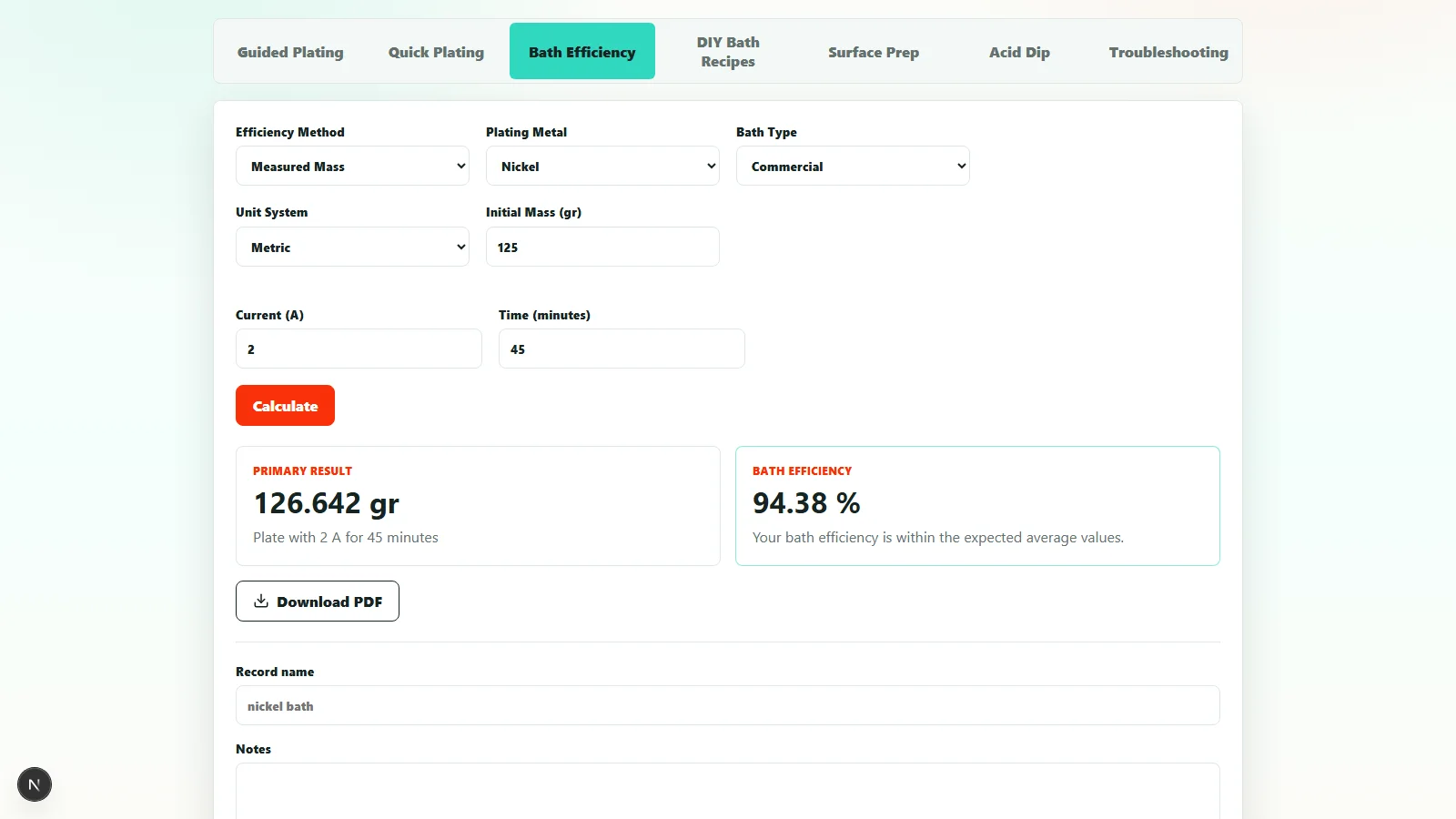
PlateLab applies this relationship:
Mass efficiency = (Final measured mass − Initial mass) ÷ Theoretical mass gain × 100
Use measured current and time—or reliable integrated charge data—rather than nominal settings when evaluating a real run. PlateLab supports the arithmetic and saved records; it does not determine why an efficiency result is high or low and does not replace bath analysis, coating inspection or the supplier's process specification.
For the broader workflow, see How to Electroplate with PlateLab.
A practical troubleshooting sequence
If measured and theoretical deposition disagree, check the basic assumptions first:
- Confirm units. Check amperes versus milliamperes, seconds versus minutes, grams versus ounces and decimal placement.
- Confirm the deposition reaction. Verify molar mass and electron count for the actual bath.
- Confirm charge. Use actual current history or integrated amp-hours.
- Confirm mass gain. Subtract clean, dry initial mass from clean, dry final mass.
- Check the scale. Verify resolution, stability, calibration and repeatability.
- Look for foreign mass or material loss. Check water, salts, oxides, inclusions, substrate attack and loose coating.
- Repeat under controlled conditions. One result may reflect measurement variability.
- Investigate the process. Review current density, contacts, bath composition, pH, temperature, agitation, additives, contamination and anode behavior.
Do not prescribe chemical additions from one efficiency result. Compare repeated measurements with bath analysis and documented process limits.
Electroplating efficiency calculation checklist
Before accepting a result, confirm that you have:
- Identified the correct metal-ion reaction and valence
- Used the correct molar mass
- Recorded actual current or integrated amp-hours
- Converted time and charge units correctly
- Weighed the same clean, dry part before and after plating
- Used a scale appropriate for the expected mass gain
- Subtracted initial mass from final mass
- Considered retained solution, residues, inclusions and substrate loss
- Compared the result with process-specific control data
- Checked local thickness separately when coating distribution matters
Frequently asked questions
What is the formula for electroplating current efficiency?
Cathode current efficiency is actual deposited target-metal mass divided by the theoretical mass predicted by Faraday's law, multiplied by 100. Actual deposited mass is normally measured as the clean, dry final part mass minus the clean, dry initial part mass.
How do I calculate theoretical electroplating weight?
Use m = (I × t × M) ÷ (n × F), where current is in amperes, time is in seconds, molar mass is in grams per mole, n is the number of electrons transferred per metal atom and F is 96,485.33212 coulombs per mole. The result is theoretical deposited mass in grams at 100% current efficiency.
Is actual deposit weight the final weight of the plated part?
No. Actual deposit mass is the final clean, dry mass minus the initial clean, dry mass. The final part mass includes the substrate, so using it directly would produce an invalid efficiency calculation.
Can electroplating efficiency be more than 100%?
A calculated value above 100% usually means the measured mass includes retained water, salts, oxides, inclusions or another material, or that current, time, units, valence or scale readings are incorrect. Review the assumptions and measurement procedure before interpreting it as target-metal current efficiency.
Why is actual plating weight lower than theoretical weight?
Possible reasons include cathodic side reactions such as hydrogen evolution, incorrect charge or valence data, intermittent electrical contact, coating or substrate loss, measurement uncertainty and bath conditions that reduce target-metal deposition. The mass difference alone does not identify one specific cause.
Does voltage affect theoretical deposit weight?
Voltage does not enter Faraday's deposit-mass equation directly. The theoretical mass depends on charge: current multiplied by time. Voltage affects the ability to drive current through the cell and determines power with current, so it still matters to operation and energy use.
Is current efficiency the same as plating thickness efficiency?
No. Current efficiency compares measured deposit mass with the Faraday theoretical mass. A thickness comparison evaluates measured average thickness against a target or prediction. Mass can be correct while local thickness remains nonuniform.
Can I calculate efficiency when current changes during plating?
Yes. Use an amp-hour meter or integrate current over time. Add the amp-hours from each current interval, calculate the theoretical mass from total charge and compare it with the measured mass gain.
Does this calculation work for electroless nickel?
No. Electroless nickel uses a chemical reducing agent rather than externally applied cathodic current. A Faraday current-efficiency calculation based on amperes and time does not describe an electroless process.
What scale resolution do I need for a plating weight test?
The scale resolution must be small relative to the expected deposit gain, and the complete weighing process must be repeatable. A 0.01 g scale provides little useful detail for a deposit gain of only a few hundredths of a gram. Use a larger test deposit when appropriate or a more capable balance, and verify stable repeated readings.
Key takeaway
The theoretical deposit mass is calculated from charge, molar mass and ionic valence. The actual deposit mass is measured as the clean, dry increase in part mass. Their ratio estimates cathode current efficiency:
η_cathode (%) = (m_final,dry − m_initial,dry) ÷ m_theoretical × 100
The arithmetic is straightforward. The quality of the result depends on knowing the correct deposition reaction, measuring actual charge, controlling the before-and-after weighing procedure and understanding that total mass efficiency does not prove local thickness or diagnose bath chemistry by itself.